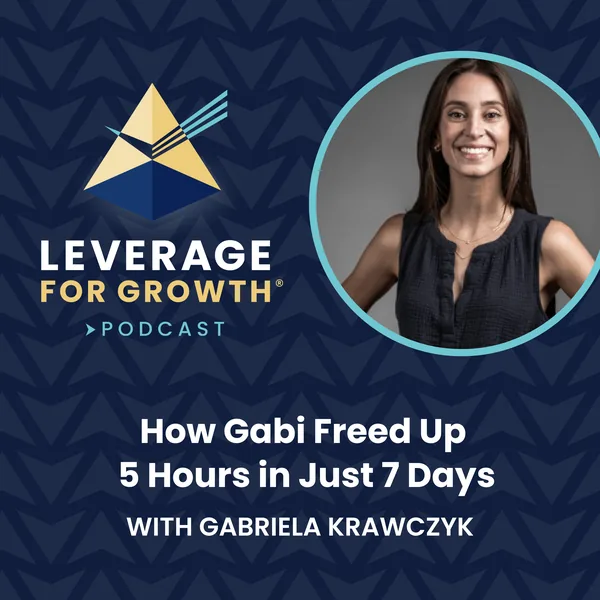
How Gabriela Freed Up 5 Hours a Week in Her First 7 Days
Gabi Krawczyk freed up five hours a week in her first week of the Free Up Founder challenge, and most of those hours came out of reactive work.
Listen to This Episode
LEVERAGE FOR GROWTH® PODCAST
March 24, 2023
In this episode, we sit down with Andrew Watson and Zach Sean, founders of Avengr. - a Nashville-based marketing agency specializing in Video Content and Web Design. Our discussion focuses on the importance of building strong relationships in driving business growth for marketing agencies. As agency owners, we understand the challenges of expanding our client base and maintaining profitability in a competitive industry. In this podcast, we explore how a focus on relationship building can help agencies establish trust, drive referrals, and increase revenue. Drawing from their experience at Avengr., Andrew and Zach share insights and tips on building authentic connections with clients, partners, and the wider business community. Join us for this insightful conversation on how to leverage the power of relationships for agency growth. Whether you're a marketing agency owner or a professional looking to expand your network, this podcast provides actionable strategies to help you achieve your business goals. Tune in now to discover the key to unlocking success through relationship building!
OFFER -
Companies - 10% off first project Freelancers - considering the switch to agency model? Reach Out! Red Bull - Drew and Zach want to work with you.
Connect with Drew & Zach on:
Web: https://www.avengr.co/ Facebook: https://www.facebook.com/avengrbrands/ Twitter: https://twitter.com/avengrbrands Instagram: https://www.instagram.com/avengrbrands/ LinkedIn: https://www.linkedin.com/company/avengrbrands/ Vimeo: https://vimeo.com/showcase/9592590
This transcript is lightly edited for readability.
Jesse: Today I am here with Drew Watson and Zach Sean, co-founders of Avengr, a marketing agency based in Nashville, Tennessee, specializing in branding, video content and web design. Thanks a lot for coming to our show, guys.
Drew: Thank you.
Zach: Yeah, thank you, Jesse.
Jesse: Awesome. Can you tell us a little bit about the history and background of your agency? Zach, do you want to take that one?
Zach: Sure, we'll keep it brief. So Avengr as we know it today started in early 2022. February was our birthday, our first birthday. But we've been working together for a lot longer than that. We met working with a property developer in 2018, working on a set of tiny home communities. So Drew, if you want to give a little background on that. But that's where we met and started working together.
Drew: Yeah. I like to tell everybody that we met on Craigslist, but Zach actually answered an ad for a job listing that was out there. I was part of a collective land development group that did marina and resort properties, and ownership didn't see eye to eye with some partners. They separated and developed different companies, and through that process I ended up being Zach's boss, which was really weird. When we first met, it was like, wow, this kid's way smarter than me.
Just fake it till you make it, that type of thing. No, it was awesome. We connected on a lot of different levels, from previous history to musical background, graphics, that kind of thing. Where he really shines, and the level of expertise he brought to Avengr, is web dev and design, and I'm more in our photo and video realm. I was hiring him to do jobs for me, and he was hiring me to do jobs for him, and after four years of doing this and working on multiple clients together, it was like, why aren't we just a thing?
So we got married, and we started Avengr. And our first year has been great. We kind of knocked it out of the park. Monthly recurring revenue is just shy of 20K a month, and on yearly revenue we broke the 200 mark right before our first birthday, so I felt great there. And I'm just looking forward to the rest of this journey. I'm really excited about coming out of the first quarter, when people don't want to spend money on marketing, and getting ready for spring launches and big retail seasons and all that kind of stuff, for the market that we cater to, which is a lot of real estate.
The Fed kind of played with that a little bit, but that's a whole other conversation. We're also working in the healthcare niche, and that's been really cool for us, and we're dabbling a little bit more in product and food and beverage these days. That's where we're targeting a lot of what we do. And I think video drives a lot of how people understand our skill set. That's how people digest who we are: oh, you guys do videos. But then it's also, well, I need a website.
And it's funny, because that's how almost every conversation has happened. Oh, you guys do videos, that's awesome, I want videos. And then, I need a website. So we end up doing a website for them and then building out all of the collateral for their marketing around it.
Jesse: Awesome. It sounds like a really good, successful first year. If you think about that first year, and maybe somebody that is just starting or thinking about starting their agency, what advice would you give them to shortcut the trial and error process?
Zach: Yeah. A lot of our success this first year has really been leveraging existing relationships, and relationships in general. Drew is an expert at making people feel good, making people feel like they're getting value out of what we're providing, and really just that communication, consistently talking to them, making sure they feel good and they're happy with whatever we do. I think that has been by far our biggest differentiator in getting to that $200,000 mark in our first year, with no previous history as a company.
Drew: Yeah. And again, we're a little seasoned, right? If you're green coming into this world, and you've picked up a camera, or you're looking to do web design, or you're offering social media services for somebody, and you haven't really been exposed to the industry, it is all about relationships, in my opinion. And something we've been able to work into our business is a bit of the retainer model, and we can elaborate on that in a second. That was a big thing for us: where do we build long-term relationship growth, and how can we become part of somebody's brand?
So that's a big key factor. And on top of that, it's meeting as many people as you can and being willing to, in a way, know your worth. I see a lot of creatives, man, who are like, oh, well, I don't want to do this because it's not paying this amount of money. And I'm like, cool, so what are you working on? And they're like, nothing. I get that, I understand. But you may want to take what you can bite off and grind and do those things, and I think you'll see immediate growth out of that.
Figure out a way. I think that's been the biggest takeaway this year. And I've got to give a shout-out to David Riggs, by the way. We do have a business coach from Numa, who has helped us. Numa is an SEO and web design agency out of Denver, and he's helped us quite a bit over the past year. But I will say that building that relationship with somebody and opening up an almost higher level of communication, almost annoyingly checking in, in some ways, to make sure that they're happy, has been huge for us.
So I really do pride myself on relationship management and client management. I would say that's a big key factor.
Jesse: And you talked about packaging and monthly recurring revenue. Was it a conscious choice to go toward a monthly recurring model? And if so, how did you figure out packaging? I know a lot of people are focused either on custom proposals or an a la carte menu. How did you guys figure out what kind of package or monthly recurring offer you were going to do?
Zach: Yeah. For your first question, absolutely, it was a conscious effort, because we'd been doing a lot of custom proposals for every project, especially in the web space, just because projects can vary so much in scope. But there's not very much predictability in that. It's a roller coaster, as anybody who's done freelance or run a small agency knows. It's feast or famine a lot, and a lot of this was built in an effort to counteract that as much as we possibly can.
Where we found our first success, we started brainstorming ideas for how we could introduce a recurring revenue model for video first. That was where we started. And we came up with a pricing matrix. Consistency is very important in video, and when you're doing content for social media, you want to hit people frequently and with high quality. So we put together these packages and this whole pricing matrix and just started pitching. At first we didn't really have any bites.
We didn't have any social proof or anything like that. We sat down with a client one day and got our first bite, and then it was just a snowball effect from there. Now that package is probably 70% of our recurring revenue.
Jesse: Awesome. Awesome.
Zach: And as far as working out what the pricing should be, that's still an ongoing process. We're pretty comfortable with where we're at, but there's a lot of opportunity. A lot of people are doing things in weird, wacky ways that we're trying to learn from as we grow. But I'll let Drew take it from there.
Drew: It's one of those things where we make it fit with a client's budget, knowing what our capability is, right? And to Zach's point about brand growth for your client, consistency is key. Let's look at UGC, for instance, user generated content. It's great to have a ton of organic traffic, and if you can put high production inside of organic, with the two of those in synergy with each other, that's where we come in. If you're already building that brand and putting out that message, let us put some high production value into what you're doing now.
If you haven't done any of it at all and you want to grab some eyes, great. So what we do is we have base pricing. We have a general outline of what we're going to come in and do and how we're going to build that out, at least on the video side. Even on our website, there are packages that we've put together that make everybody feel warm and comfortable. It's a lot different if we're going to travel for a developer in Texas, compared to what somebody's going to pay locally in Nashville, Murfreesboro or Franklin, because you're just going to have different variables.
But the package could probably remain the same, and the variable isn't extremely difficult to figure out. It's how much travel is going to be, and tacking that on. So it's been great to productize it as a service, because when you're a freelancer, it's just, here's my hourly, and then you've got to figure it out from there, and that doesn't really work well with people. And then you underbid a job and work on it for way longer than you thought you would, and you're like, oh man, I'll never do that again.
So I think we're really happy with where we've been, and there's always room for growth. We've had clients who were two, three, four months into a year-long project, and then they're like, hey, can we add this or change this up? Anything that we can figure out to make it a better experience for them, absolutely.
Jesse: Awesome, awesome. So what is success for you guys in the next one to three years? What are you working on right now, and what would be success going forward? Zach, do you want to take that one?
Zach: No, go ahead.
Drew: Okay. So it's tough, right? I don't want to just put a dollar amount on everything and make it seem like it's only revenue driven, but there is a bit of that. We do want to grow as much as we can with this retainer model, which basically puts our monthly recurring revenue at a number that we're really happy with, and we're on track to do that. The variable comes in from the one-offs, the single sites, the non-managed work, and that can ebb and flow a lot.
Last November we saw it change significantly. We didn't think we were going to make any more money for the rest of the year, and then November turned out to be one of our best months. It was just crazy. So I think there's a target number, and I'd like to say that within year two we'd be over that 250 mark, hopefully even north of three. And then for year three, I'm all in on trying to do that 500. Now, to get there, our strategy is changing a little bit.
We're very local, and we market locally and do a lot of things of that nature, but we're also changing up the brands that we approach and working a little bit more to produce content in niches that we haven't found ourselves in yet. But it's all a proving ground thing, man. If you do something cool for somebody, word of mouth just starts to go. So that's what it is: focusing on growth in the markets that we want to be a part of. And hey, Red Bull, if you ever hear this, we'd love to produce a piece for you too, because why not?
We'll see. But our plans and steps to move forward are all in that big direction, and the marketing efforts are all over the map, with cold email and DMing and just outreach. We're seeing growth, but it's an everyday grind for sure.
Jesse: Totally. Zach, did you want to add anything?
Zach: I think those are obviously the monetary goals. We have our own personal goals individually and then as a collective. I think a lot of it is financial freedom, right? If we want to talk entrepreneurship, it's the freedom of being able to make these decisions for ourselves and put a lot of value and purpose behind the things that we do on a day-to-day basis. We've all worked for the man, or whatever. We've done those things, and it's good, but there's nothing quite as purposeful as working for yourself and doing something because it makes you happy and because you believe in it.
This last year has been incredibly stressful in a lot of ways. It's been a lot of learning and a lot of mistakes. But at least for me personally, it beats the hell out of the last four years of going through similar stress but not even for my own personal gain. So there are a lot of goals in that. We want to continue growing and continue becoming more well-rounded people. How can we use this growth in our personal lives, not just in a monetary way, but in terms of what that money and that time and freedom allow us to do?
Jesse: Awesome. Living the life of entrepreneurship, the dream of entrepreneurship.
Drew: Yeah. I think if you have that itch, you need to scratch it. Like what Zach was saying, it sure beats working for the man. I have a problem where I just couldn't hold a job, really. I'm so ADD, and I want to be doing things and be involved. Whether people call me a control freak or not, I have a producer mindset, and that can't rest if I'm confined. And if you feel that you're like that, if you feel that you've got more to give, or you're stuck in a situation where it's like, man, I'm just paying the bills but I'm not happy, I advise everyone and anyone who feels there's some sort of itch to scratch: get out there and try something, even if it's moonlighting on weekends.
Go be a weekend warrior with your thing. But if it starts to pick up steam, don't fight the urge, and don't be afraid. Like they say, everything good happens on the other side of fear, right? And that's what a lot of it is. I feel like for freelance creatives who end up getting stuck in a salary job, some nine to five that they're not necessarily happy with, they're like, well, I do graphics for a bank, but at least I'm doing graphics. And it's like, yeah, but you're a beautiful illustrator, and you need to be doing tour posters or something.
Whatever your thing is. But don't be afraid to take that risk. I found myself there way too many times. Even when I was 14, it was, go sweep the floor, and I was like, nah, I want to make music, so I'm going to go do that. So I don't know. Follow it. Follow it, for sure.
Jesse: I love it. Awesome, guys. What's the best way for people to get in touch with you, or do you have any offers that they could take advantage of?
Drew: We do have an offer. The best way to get in touch with us is at avengr.co. That's A-V-E-N-G-R dot co. You can book a call if you ever want to talk shop. We'd be really happy to. So if you are a freelancer looking to start a thing and make it bigger and go the agency route, or you're a producer in any way, shape or form, we're always looking to collaborate with people too. So again, if you're hearing this, reach out, man. We'd love to touch base. All of our socials are at Avengr Brands, so check that out.
Again, we spell it a little funky, A-V-E-N-G-R. And if you're looking to onboard with a new agency, or you want to produce some really cool content, we do 10% off your project total at kickoff. And for other creatives out there, maybe you work in the world of augmented reality, or you're doing Instagram graphics, but you could really use a web design agency or you want a videographer to partner with on something, we do a referral as well. So come on over and say what's up, and we can all work on a project together.
That'd be great.
Jesse: Cool. Awesome.
Drew: Yeah, Jesse, thank you for having us, man. This is cool. I'm excited about your growth too, and congrats on taking the leap with the whole podcast journey. That's awesome.
Jesse: Yeah, thanks a lot. All right, well, you can hear more from Drew Watson and Zach Sean at Avengr, avengr.co. Thank you very much for being on the show, guys.
Drew: Thanks so much, Jesse.
Zach: Yep, cheers.
Transcripts are auto-generated and may not be 100% accurate.
Gabi Krawczyk freed up five hours a week in her first week of the Free Up Founder challenge, and most of those hours came out of reactive work.
Listen to This Episode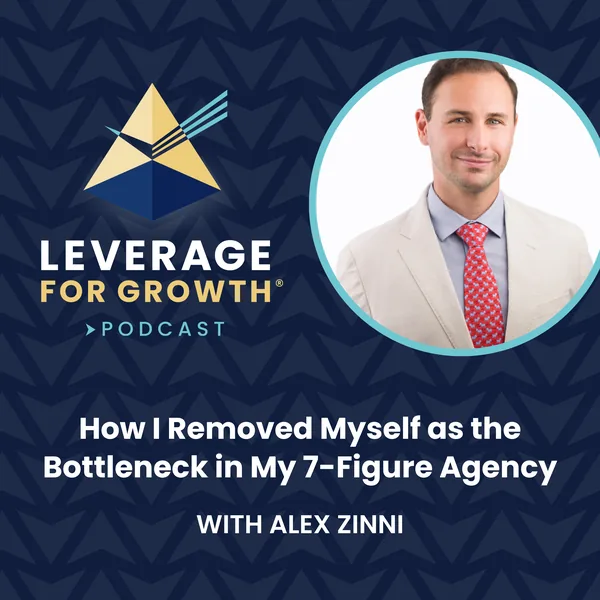
Alex spent a decade as the bottleneck in his own 7-figure agency. In 4 months inside the Leverage for Growth method, he built the systems to step out of it.
Listen to This Episode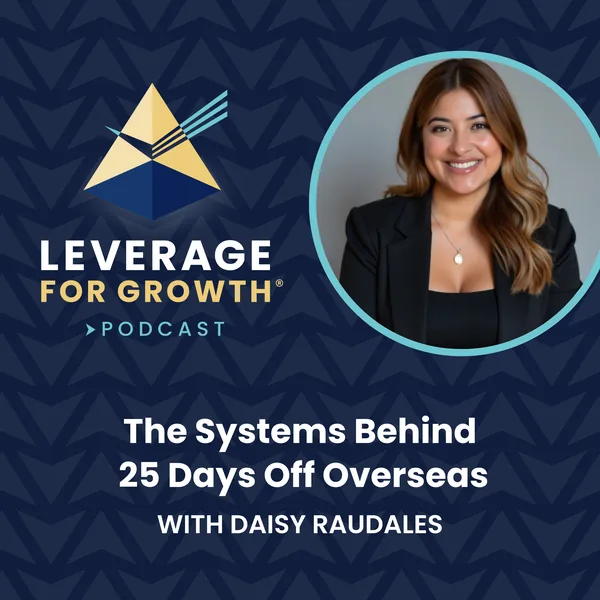
Daisy Raudales spent 25 days in Europe and her PR agency did not fall apart. She went a little viral for saying so.
Listen to This Episode