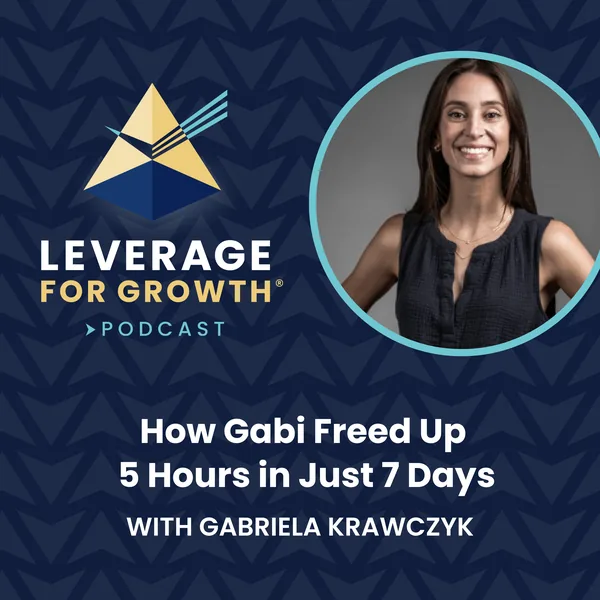
How Gabriela Freed Up 5 Hours a Week in Her First 7 Days
Gabi Krawczyk freed up five hours a week in her first week of the Free Up Founder challenge, and most of those hours came out of reactive work.
Listen to This Episode
LEVERAGE FOR GROWTH® PODCAST
May 7, 2025
What does it take to transform a legacy agency into a modern growth engine? In this episode of Leverage for Growth, Jesse Gilmore sits down with Chad Bauer, CEO of one of Baltimore's oldest advertising firms, SR&B Advertising, to unpack how he transitioned from inheriting a 60-year-old agency to leading it into a new era of innovation, culture, and brand-driven growth. Chad shares hard-won lessons on leadership—like learning to delegate, saying no to protect your vision, and why overthinking can slow you down. He also breaks down the shift from performance marketing to true brand building, and what it means to create a team that feels empowered to contribute. If you're scaling an agency, navigating a family business, or wrestling with letting go of the day-to-day, this conversation is packed with insight. Legacy vs. reinvention Delegation and the power of trust Brand depth over performance noise Communicating vision that drives culture Building a destination workplace
Chad Bauer is the President & Owner of SR&B Advertising. With over 25 years of business and marketing experience, Chad has consulted with thousands of brands, delivered award-winning results, and led SR&B Advertising to become a leading performance and growth marketing agency. His dedication to fostering a “fun work, fast growth” environment, innovative strategies, and exceptional client results has positioned the agency as the destination of choice for top marketers and brands looking to perform & grow. Beyond his professional accomplishments, Chad is a devoted family man and enjoys outdoor activities. He is also actively involved in giving back and supports a wide variety of organizations and causes. Looking ahead, Chad’s vision for SR&B Advertising is to provide a culture that allows marketers to thrive, in order to influence the industry and inspire others to deliver positive impact and influence in the world.
Connect with Chad and SR&B Advertising - Web: https://www.srbadv.com/
This transcript is lightly edited for readability.
Jesse: Today I'm excited because I'm here with Chad Bauer, the owner and president of SR&B Advertising, a full-service omnichannel performance and growth marketing agency for brands serious about growth. Thanks for coming to our show today, Chad.
Chad: Thank you for having me, Jesse. Looking forward to the convo.
Jesse: Awesome, man. Can you tell us a little bit about the history and background of your agency?
Chad: Sure. Our agency is a little bit over 60 years old. We were founded in Baltimore, Maryland back in 1964. My father acquired the firm back in the late 80s and ran the team for about 35 years. I came on about 12 years ago to take things over and hopefully grow this thing into something a little bit bigger. Historically, we've delivered traditional advertising and marketing services. So your television, radio, print, commercial production, design and layout services.
However, that's kind of morphed in recent years, and we're really at this point focused on growing this team into something more than what it has been traditionally. Our service offerings have changed and evolved over the years. Our go-to-market strategy, how we acquire business, retain business, and ultimately serve our greater community is something that I've really been focused on in my last 10 years on board. So that's kind of who we've been up to this point.
Jesse: Awesome, man. I think you are the first podcast guest, marketing agency owner, that has an agency over 60 years old. So that's quite a journey, and probably a lot of things have changed since the 1960s.
Chad: Yeah. Well, just a few. I will say I was very fortunate to have the opportunity from my father to come on board after what he had built and the foundation he had worked so hard to establish over the 35 years he was at the helm. Having that opportunity was one thing, but also the confidence in him and the rest of the team to be able to do something special with us after 60-plus years. Fun fact, we are one of Baltimore's oldest and original advertising agencies, which is pretty cool.
Something to be proud of.
Jesse: Absolutely, man. And you said you joined the agency and started working for it about 12 years ago.
Chad: Yeah, roughly about 12 and a half or so, coming up on 13. I was on the media side, in media sales for a large media publication company and distributor across the world. I enjoyed that corporate experience and what that was all about. But I got bit by the entrepreneurial bug when I was 13 years old, and pretty quickly into the corporate world I realized that one day working for myself and being a servant leader to others was really what I wanted to be and what I wanted to do.
Jesse: Mhm. Did you know from the get-go that you were going to take over the agency when you first started 12 years ago? How did that come about?
Chad: So my father didn't have an exit strategy. My father was an owner operator. He grinded from sunup to sundown to support not just our family but the families that were tied to the agency through his staff. And as I came on board, I kind of had my head down and did what I knew best, which was mostly sales and developing new business for the firm. Then once he brought me into operations a little bit and showed me how things worked, that's really where I started to become excited and motivated, and I felt challenged: all right, he's got something cool here.
What can I build on top of this? I'm always forward thinking, and I immediately saw opportunity for a firm with this type of history and the type of people that we have. Our team and our personnel, I was just proud to be a part of it. So in short, to answer your question, when I came on board I think the idea was that maybe this could be an exit strategy for my father, and he'd have something to do with the shop when he was ready to retire. But it really didn't hit me and sink in that this is a really cool opportunity that I was salivating for until probably three or four years in.
Jesse: Mhm. Awesome.
Chad: Since then, my father has retired, and I acquired the agency a few years ago. So we've made it through a fairly challenging transition, both the good and the bad. I'm very fortunate that I have the family that I do, and that, like I said before, they trusted me but also gave me the leash to do my thing, spread my wings and fail forward. My father always said, I don't have the answers to everything, and you're not going to either, but surround yourself with good people and be a good leader to them, and it'll pay back.
I certainly didn't have the answers as I was doing my thing and trying to grow this place.
Jesse: Awesome, man. Walk us through a little bit about that transition point where you became the owner, you became the president, you took the reins. What was going on, how did you set up for that, and what were some of the experiences around that transition that stand out for you?
Chad: Yeah. I think it's one thing to say we're going to change, or we're going to do some things differently around here, maybe change the way we approach certain projects or certain relationships with clients or vendors, for that matter. I think it's another thing to feel that change and actually see it. And transition is kind of a fancy word for change, really. Nobody likes it, and as humans, change is tough. It's difficult. But I kind of had a little bit of a problem saying yes to everything and having this sense of, all right, I'll figure it out.
Yep, just put it on my desk. I'll get to it. I'll get to it. And I think that worked for a little while, until we started bringing on more clients and more work. And I finally had a realization that the best thing for me was to learn when to say no, right? Learn when to delegate and learn when to assign responsibility. And at that point, as we were going through some of that transition, once I realized that, I was able to almost go into neutral for a little bit and figure out which direction was my next best step if I was going to begin to delegate and assign more to the current team, in addition to new people that we needed to hire and bring on board.
That was going to be my true value to the company. And on top of that, being able to go out and sell again and represent the firm on the front end and be the face of things to develop new business and more relationships in the market. I wouldn't be able to do that if I was touching everything along the way. So, like I said with my father, an owner operator who built a great business, and it was awesome to have that opportunity to build from. The transition helped me realize that if I truly wanted to achieve what I want, I needed to begin to delegate and be more of a high-level leader than what the firm had experienced in previous years.
Jesse: Mhm. One of the cool things about the story so far, as we look back and see this transition, is you came in on sales, then you started getting into the management piece, and now, as you took it over, you're moving into more of a leadership role. And I know from previous interviews with podcast guests that when they're going through it, there are some things that are challenging about those transitions, but they're also very necessary. One of the things that you talked about was the need to delegate.
And the interesting part is that you're getting to a place in the agency where you're repositioning yourself based around your strengths. You came in from the sales side, and now you're delegating to teams more and being more in the leadership role, but also being on the sales side. Aside from the need for delegation, what are some of the things that you learned through that experience, or through learning how to position yourself in the agency, that maybe you wish you would have known in the beginning?
Chad: If I was to look back on things and determine, knowing what I know now, what I wish I knew back then from the get-go, it's tied to what I was saying before: saying yes to everything can really dilute your impact. When you're trying to grow something, whether it's from the ground up or building on top of something like what we're trying to do here, especially for those of us who naturally like to take ownership of things, it's easy to overextend ourselves.
It's easy to just say, "Yes, I can do that, because I've done it before, or because it's something that somebody else on the team has done before." And it's tough to use the word trust right out of the gate with something, but over time I have learned to trust the team members more, set clear boundaries, and really turn around and look at myself and focus my energy where it actually matters most. I don't think scaling this business is about just doing more, right?
Saying yes to opportunities and just doing more and more work. I think scaling is about doing the right things with the right people here at the company. So if somebody would have said to me, "Hey, approach your day-to-day with this type of mindset," like I just described, from the get-go, that would have been very nice, to not have to go through that individual learning curve myself.
Jesse: Mhm. There are so many people that get stuck thinking, okay, I'm at a million. In order for me to get to two million, I just have to do double the amount of work. And I think a lot of people get stuck in that trap. At least from my own experience talking with agency owners, a lot of times perfectionism is a big piece of that, the inability to actually let go. There's a saying, 80% done by somebody else is 100% awesome. I think Dan Martell said that.
That kind of framework is sometimes really hard for people to grasp.
Chad: One thing that I wish I'd known from day one, or at least learned earlier than I did, was to just not overthink stuff so much. I tend to put a lot of time into trying to be perfect and trying to make sure that I'm making the right decision, whether it be on a proposal to a client, or a hiring decision, or a resource conversation with a staff member, that sort of thing. I've always overthought, and I kind of wish somebody had shaken me early on and said, "Hey, no matter what you try and no matter how perfect you are, you're going to fail.
It's natural." And we hear that a lot in everything that we read. But I think it would have been cool to be shaken in the beginning and told, "Hey, don't overthink things too much. Trust your gut, trust your experience, go with it, fail forward." And now that I really grasp onto that, I'm probably making decisions too quickly, but I'm certainly not holding myself back like I feel like I was for some of those early years.
Jesse: Yeah, it kind of reminds me of the law of diminishing returns. You get to 60, 70 or 80%, and at that point you can get feedback or have somebody else come in. There are a lot of diminishing returns in trying to get from 80 to 100% by yourself. It ultimately just takes way longer than is actually needed. And, I guess as a pivot in the conversation, because we talked a lot about the delegation piece: let's say we delegate the work to somebody else. One of the biggest things that I have realized working with you and talking with you is that you're not in a management role.
You're more in a visionary leadership type of role, which is another kind of switch. When you look at the vision, what are some of the things that you've learned through communicating your vision to the team? Because you have to be able to communicate things differently than what happened in the past, just off the cuff. I know this wasn't one of the questions, but what comes up for you around communicating a vision to the team?
Chad: Yeah. You're totally on with that, and I think everybody would agree communication is key. Whether someone's been here for 10, 12, 15 years or they're starting next week, I'm always very clear about discussing with them that if there's ever a question, if there's ever something up, we have to communicate. We're only as good as a team if we can communicate and connect on things when needed. From my experience, I've found that saying things, whether it be in person or at a meeting or in an email, certainly sets the tone, right?
It allows the team to understand what I'm thinking and perhaps what I'm planning. And based on personality, work style, mindset for future and growth and all of that, depending on the team member, some people latch on to what you say right away or read in an email that you send them. Other people maybe don't latch on and are waiting to actually see things in action. So I've found that saying things and talking about things is great, but taking action really is what pushes things over the edge and gets everybody to align with that vision.
There are things that I've implemented in the business over the last two to three years that I wasn't doing before when leading the team, and that previous ownership wasn't doing. In order to grow a team and a business around what we're trying to do, and really our goal for this year is to become a destination employer for the best marketers in the area, communicating that vision and effectively showing the team what can be done has been really impactful for me.
And as we grow, there's a lot of chicken or the egg. Do you bring on the next client before you make the next hire, or do you hire first and then go out and bring the revenue on? I don't think there's a straight answer to that. I think it's case by case, agency by agency, business by business. And it never stays the same. It's always changing and evolving, which makes it fun but equally fairly stressful. So where I'm at, with what we're trying to do and how we communicate, it's a little bit more regularly scheduled meetings.
We're a small team. I'm not trying to turn this into some corporate shop or anything of that nature, but that's one extreme as I see it. And the other extreme is low-level communication, no clear vision, no clear insight for the team about the vision of the business or what I might have from the top down. With my vision, we need to be in the middle. And I think the things we've done in recent years are bringing us more to the middle of that space, which I think will be really comfortable for a decent-sized team, people looking for personal growth in their career and upward opportunity within the same organization.
So if we're communicating, and we're showing it in action, not just through words, we get buy-in. And next thing you know, we're getting people actually raising their hands and offering ideas and contributing more to the bigger picture.
Jesse: One of the coolest things about what you just said: we've talked about the journey, not only from starting 12 years ago to taking over about three or so years ago, but going from an owner operator type of role into more of a visionary, and all the different transitions that happen. Perfectionism was one of the biggest things that needed to be let go so you can delegate. The other piece was figuring out how to communicate a vision. It might be different than what people are used to, and having it regularly scheduled.
It doesn't have to be corporate, but you do need to communicate a vision, and you need to do it on a regular basis. And one of the coolest things you said just a second ago was that when you start communicating that vision, people start raising their hands and offering help toward achieving it. I think that's one of the most beautiful transitions within the journey that you're sharing right now.
Chad: Thank you. I would agree with that. When you look at your colleagues and your team members and the people that you're leading, it's hard sometimes to take yourself out of your own shoes and put yourself in theirs, person by person, because everyone's so different. I think one of the biggest realizations is that there are people on your team that want more. There are people on your team that desire to contribute more. There are people on your team that maybe don't want any more, and maybe that's okay.
But doing what you were just describing, and what we've experienced in recent years, naturally gives them an opportunity to feel comfortable stepping up and saying, "Hey, I've got an idea." Whereas without that communication of vision and that clarity around where the ship is going, the direction this cruise is headed, they may be more reluctant to raise their hand, because they don't know. So I think that's been a huge thing. It has empowered our staff in different ways across the board, which is pretty cool, pretty exciting.
Jesse: And speaking of which, what are you excited about over the next one to three years within the agency? What are you working on? What are you excited about?
Chad: Oh my gosh. I'm excited about everything. I think the only thing I'm not excited about is all the HR nonsense I know I'm going to have to deal with. Just not something I'm a huge fan of. But regardless, we'll stay positive. Everything, man. There's so much cool stuff happening. I think the biggest thing I'm excited about right now is our people. We've brought some new resources on in probably the last two, three years. That was our most recent rush of talent, and they're awesome.
They fit into the team so well. The culture is so fun, everyone feels like they can be themselves, and it's just cool to walk in and hear people having fun and enjoying their time, when I know they're away from their family or their children. They're devoting units of their life to this business. So it's really cool to experience that. And prior to that, I brought a pretty important key player on board to run our digital and be our VP of digital. That was a monumental change for us in terms of how we were able to go to market, the services and solutions we could provide clients, our general way of thinking, and being a partner and a true resource for our clients.
It has evolved so much since he joined the team. So the people part of where we are right now is what I'm looking forward to the most, and growing that, even though I say the HR side is kind of my biggest thorn. I think that can easily be resolved by finding a lead, or finding someone to come in and help me keep that side of the house in order. I'm also really excited about our opportunities with new business and the types of clients and brands that we can be working with now.
If you'd taken a look at our website six or seven years ago and then looked at it today, we look like two totally different businesses. We've gone through a little bit of a brand refresh as we've evolved, again, our services, our people, our capabilities. But the roster of clients, the portfolio style of clients, and the type of work that we've been contracted for just in the last 12 months has been so rewarding to see. Hey, we got the contract from this brand, now we have this brand on the roster.
That's probably due to my background in business development and account management. I just love that. That's super exciting. I think the staff recognizes it too: oh, wow, we're doing work for them now. Awesome. Let's go. I've always had ideas for that brand, or I've always wanted to pursue a campaign for a client in that vertical or that industry. So it's bringing a pretty positive sense of encouragement to the rest of the staff when we bring on some of these accounts and brands, which has been great.
And I think there's a big opportunity in our space right now. We call ourselves a full-service omnichannel performance and growth marketing agency, right? Advertising is a form of marketing, as we know, and there are a lot of different spokes off of the marketing wheel. Advertising is in our blood. It's the core of what we do, but there's so much tied to it now outside of just putting an ad together and testing a message on a channel with an audience.
Once you get that defined, that's the performance side of things, and making sure that clients understand that we need to set expectations before we get into this campaign, before we start spending money and trying to drive results toward your goals and objectives. ROI is important. Whatever the ROAS is on this spend, those types of metrics are all great, and performance is awesome. Performance marketing has grown drastically in the last eight years.
However, I think we've all gotten a little lost in the performance marketing clouds. As some of you may or may not know, performance marketing has its law of diminishing returns, like you were saying earlier with that other topic, Jesse. You get to a point where you've maximized and saturated your total addressable market or your target audience. And I think some brands, some rather big ones, have realized in recent years that they put all their eggs in that performance marketing basket to try and squeeze as much revenue and juice out of that spend as they can.
And I think brands are starting to realize this more now. This is the transition I'm speaking about. Growth marketing is what we really need to be focused on. And the brand side of it, right? Growing the brand at the top of the funnel, creating a moat around our brand and around what we stand for, is a really big thing. Granted, we know that not every one of our clients has unlimited budget and can invest in all phases of the funnel to grow their business.
But I always say, and I stated this before about our business and everybody listening, same thing: you're in business for two things, acquiring new business and retaining the business that you have. And when I look at our clients, it's the same thing. Yes, there is growth and retention through performance marketing, but you certainly aren't going to see that exponential, continuous growth if you're not investing in the brand. If you're not investing in telling the story, and why people need to trust you, or how you might be different from your competitors.
I think it's all about depth over noise. The brands that are winning right now, they're not just pushing content out there and seeing what sticks. They're creating trust. They're creating community. And they're creating a sense of shared values, whether it's through an advertising message or a marketing message. People want connection. They don't just want promotion thrown at them. And so there's a fine balance. On the performance side, run the promotions: buy one get one, 20% off the first order, whatever it might be.
That's going to help you align your numbers and get you where you need to be on the performance side from a return on investment perspective. But regardless of that, there are people that are tone-deaf to the promotion. They don't want to see all that. They want to understand who you are as a brand. Why do you stand for what you stand for? How are you different from the competition? So, to wrap it up, tech and AI are accelerating what's possible for everybody in the world right now.
But the brands that stand out right now still feel human. They are authentic, they are consistent, and they are very clear on who they serve. And that's something that I feel we have an opportunity to really help our clients and future clients with as the landscape continues to evolve and change.
Jesse: That's exciting, man.
Chad: Yeah. I could probably continue to talk on that one for a little bit, because there's a lot to be excited about. We're renovating office space. We're doing a lot of cool stuff, a lot of fun stuff.
Jesse: I'm telling you, we'll just have to do another podcast interview sometime soon.
Chad: Maybe when I'm not swinging a hammer putting up drywall.
Jesse: Awesome. So if anybody's listening and they want to get in touch with you or learn more about your agency, what's the best way to get in touch?
Chad: The best way to get in touch would be either directly through our website, which is srbadv.com, or you can look for me on LinkedIn, Chad Bauer. Connect with me, shoot me a DM if you'd like to chat. I am a people person. I invest in my people here at the firm, and I'm a big believer that people are what make the world go round. I love to surround myself with teams of advisers and people that are smarter than me to help lift me up and support what I'm trying to do.
And whenever I can give back or help somebody get through something, or support them through something that they're going through, I'm always willing and happy to do so. So even if it's just, "Hey, got a quick question about this," or "Have you experienced that," shoot me a DM on LinkedIn and I'll definitely get back to you.
Jesse: Sweet. And for anybody that's listening, links to Chad and SR&B will be in the show notes. And Chad, I just want to thank you so much for being on the show today, man.
Chad: Absolutely, Jesse. Thank you for having me. It was a pleasure.
Transcripts are auto-generated and may not be 100% accurate.
Gabi Krawczyk freed up five hours a week in her first week of the Free Up Founder challenge, and most of those hours came out of reactive work.
Listen to This Episode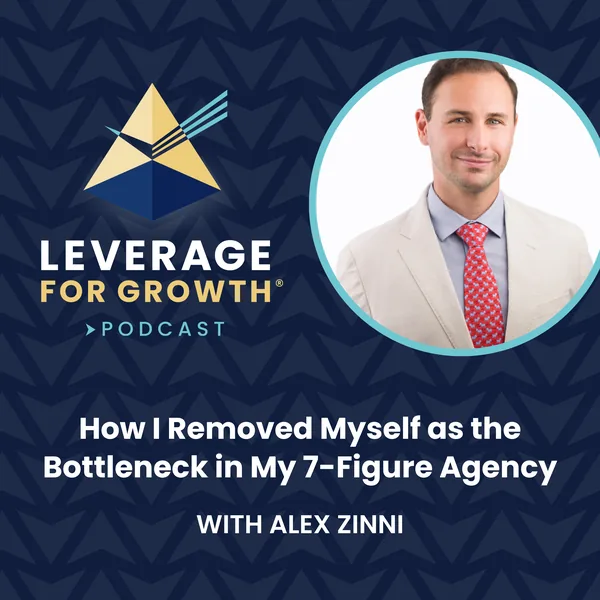
Alex spent a decade as the bottleneck in his own 7-figure agency. In 4 months inside the Leverage for Growth method, he built the systems to step out of it.
Listen to This Episode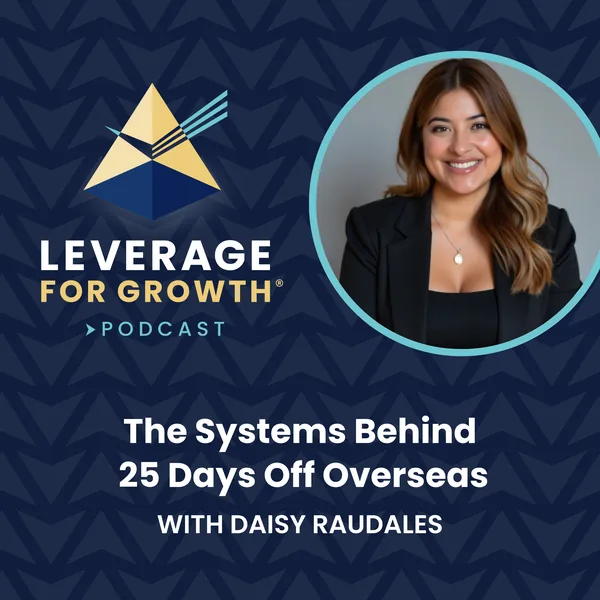
Daisy Raudales spent 25 days in Europe and her PR agency did not fall apart. She went a little viral for saying so.
Listen to This Episode