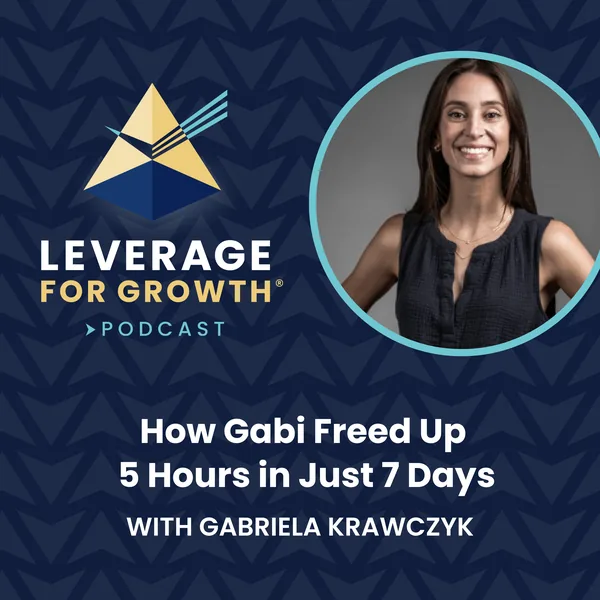
How Gabriela Freed Up 5 Hours a Week in Her First 7 Days
Gabi Krawczyk freed up five hours a week in her first week of the Free Up Founder challenge, and most of those hours came out of reactive work.
Listen to This Episode
LEVERAGE FOR GROWTH® PODCAST
February 21, 2024
We are back for Season 2 of the Leverage for Growth Podcast! Today, Jesse P. Gilmore is joined by Corey Quinn who is about to release a new book titled: Anyone, Not Everyone. Corey has a 25-year track record of extraordinary success as an entrepreneur, sales leader, and former Chief Marketing Officer for Scorpion, a $150M+ agency serving SMBs. In this very special episode, Jesse & Corey will dive into deep specialization, delivering the know-how you need to be seen as a specialist, rather than a generalist, in the market. Do you feel like your agency doesn't stand out from other agencies in the market? This episode is for you! Are you wondering what to do with your current clients when you are about to niche down? This episode is for you! Are you worried that the market you are targeting is already saturated? This episode is for you! Get ready to experience an earthquake of knowledge! No joke! 45:28 It's all here in the 57th Agency Leverage Episode of the Leverage for Growth Podcast.
Corey's book "Anyone, Not Everyone" launches soon! Check it out here: https://www.anyonenoteveryone.com Connect with Corey Quinn online - https://www.linkedin.com/in/coreyquinn/ https://www.coreyquinn.com/ https://www.youtube.com/@coreyquinninc
This transcript is lightly edited for readability.
Jesse: Corey, thanks a lot for jumping on. I've actually been very excited. I've spent almost the entire week talking about niches, or whatever you call it these days, right?
Corey: Vertical specialization. That's what I call it.
Jesse: Awesome, man. Well, my company's called Niche in Control, and I know that you're even writing a book about this whole topic, so it's a good topic to talk about.
Corey: Yeah, it's my favorite topic. Ever since leaving an in-house role at the agency that I used to work for, I asked myself, what problem do I want to specialize in solving? And the thing that I love doing is helping founder-led agencies escape the founder-led situation that a lot of generalist agencies find themselves in, where the founder is running the sales. I've fallen in love with this problem of helping them escape by becoming a vertical market specialist.
That's certainly not the only way an agency can scale. I've seen a lot of great SEO agencies and whatnot do great and scale really well. However, what I'm particularly interested in is scaling an agency by building expertise within a specific vertical industry and leveraging that expertise.
Jesse: Yeah, it reminds me of the webinar we did together about specialization. You can specialize based on what you do or who you serve, or a combination of those.
Corey: That's exactly right.
Jesse: I know a lot of people have a lot of questions, and we've listed out some questions and different scenarios that people go through. So today I would love to talk to you about those scenarios and get your take on how you would tackle them or what advice you'd give, and we'll go back and forth more as a dialogue than anything. I know that a lot of people get stuck in the complexity of niches, trying to figure out, did I choose the right one, and a bunch of things.
One thing that I've learned in the process of helping agencies figure out their niche, focusing not just on the target company or demographic piece but also on the psychographic understanding of their current state and desired future, is that it's not really a destination. It's more of a journey. Has that been something that you've also experienced yourself?
Corey: Maybe say more about that, because I want to make sure I'm really clear about how the psychographics come in. Are you saying that you help guide your clients to identify and focus on a niche based on the psychographics of that specific market?
Jesse: Yeah. One of the things that we focus on is humanizing the message in the market and really getting clear on what problems you're solving. What's the current state and desired future of your ideal client, and how do the services that you're offering actually move them from where they are to where they want to go? It's a different way of looking at a niche. A lot of times people base it off of an industry or different things. We start looking at the holistic picture of the solution too.
A lot of the clients that I'm working with have smaller agencies. They range from solopreneurs all the way up to maybe 10 employees. I have a couple of clients that are around 15 or so. So when we're looking at the journey piece, the founder's interests and passions matter a little bit more for figuring out what niche or specialization they have, where it might be a little bit different with agencies that are a lot bigger, where it's focused around service.
Corey: So in other words, a method for finding a good niche to target is based in part on the founder: what they have an intrinsic interest in solving, a specific type of problem, regardless of whether or not those clients all fall in one industry. Is that kind of what it is?
Jesse: Yeah, because there are some things that are based around industry. Industries are easier to target. If you're like, oh, manufacturing, that's easy, right? But a lot of times, if you just focus on manufacturing, you don't really have the kind of message that will pierce through the noise of a noisy market. And the reason it's so important for a founder, especially in the earlier stages of the game, to have a passion, or be able to rely on something that they're very competent in, is that it'll show in their sales calls if they're not passionate about it.
And I find that one of the biggest challenges people face when it comes to niches, and figuring out their specialization at the earlier stage, is that they feel as though the value to a client is based around putting more things in a bag. It's like if you go to a grocery store to get lasagna ingredients, but you keep putting more ingredients in that have nothing to do with lasagna, thinking about value as more things in the grocery bag as opposed to the actual recipe.
Does that make sense?
Corey: Yeah, I think so. A pattern of success that I've seen in the agency founders that I interview on my podcast, and these are agencies that have verticalized, or in other words specialized in serving one specific vertical market, whether it's roofers or attorneys or dentists or whatever it is: the ones that do really well intrinsically are the ones that have some kind of connection to that vertical market. Maybe they have a family connection, maybe their parents are dentists or whatnot, or maybe they came from a career in that market before starting the agency, so they had a head start.
They understood the major players and so on and so forth. But those things are also not required. I'm thinking of Alex Membrillo. He's the founder of Cardinal Digital Marketing. They started off as a generalist, and they were getting crushed by all the challenges of serving too many different types of businesses, and he decided to niche into a vertical market. They decided on medical practices because he wants to help people. Of all the different choices that he researched, one of the reasons he chose medical practices, specifically multi-location medical clinics, was that he felt by serving that community he would indirectly help a lot of other people.
If these healthcare companies, these clinics, are better off through better marketing and better strategy, then he'd be able to fulfill his vision for himself and for his agency of helping more people. Sometimes it comes down to that, right? Having care not only for the people that you're serving but also for that industry. The agency owners who approach verticalization or niching down from that give-a-damn perspective, you've got to give a damn, in my experience, versus treating a market based off of a spreadsheet.
Well, there are a lot of businesses and they have good budgets, and if we can get 0.5% of the market, we're going to be successful. You need that, but you also need to layer on the care aspect of that approach in order to be successful, in my experience.
Jesse: And I think that touches on why I focus on helping agencies with niches, and on the human aspect of things a lot of the time. Because business should be fun, number one, and it should actually make an impact. I truly believe that entrepreneurs in general are one of the greatest gifts to the world when they can let their vision be brought into the world and provide a great experience for people and make an impact. So yeah, the give-a-damn part, I like that.
Corey: You've got to give a damn. So much so that I've coined a term called deep specialization. That's when you specialize beyond just the spreadsheet and you actually have empathy for the individuals and the industry you target. That's the method that I teach.
Jesse: That's awesome. I'm starting to realize a lot more about why I set things up the way I did. I never even thought about the empathy piece. I always just thought about the human aspect. And there is a feeling of empathy that comes from understanding a lot more about the human aspects of the person that you're trying to help.
Corey: Yes. And I'll tell you why it matters for longevity. If you want to stick around for the long run, you're going to go through some market cycles. You're going to go through highs and lows. And as an example, it's the agencies that leaned in during COVID that are now growing 70%. There's a woman, Nicole, who has an agency called Break the Ice. Her focus is the travel and tourism industry, and she's been around for almost 20 years. Of course, when COVID hit, everything was in lockdown.
The entire industry that she was serving, the entire revenue source that she and her employees depended on, was in complete lockdown. And instead of pivoting out, she launched a podcast and she wrote a book, and she didn't lose any employees. Revenue was barely impacted, despite staying in this very difficult vertical. And as a result of doing all this thought leadership and giving back to her clients and the industry itself, coming out of COVID she's going to grow 70% in 2024.
I think she doubled her revenue last year. That comes from having empathy. If you don't have empathy in that situation during COVID, when your focus is travel and tourism, you're out of there, and you're going to have to start over.
Jesse: Mhm. That's an awesome story. And what you said right before that story, that if you're in it for the long haul you're going to experience a lot of different cycles: I think it's really important, when you're choosing a niche, to come from a foundation of understanding why you're in there. There's got to be something that's pulling you, as opposed to pushing you. There's more of that intrinsic motivation piece.
Corey: Yes.
Jesse: I find that a lot of other agency programs that serve similar groups of people are just focused on what's the high-ticket niche. HVAC? Okay, let's go into HVAC. And it saturates the market, and there's not a lot of the intrinsic motivation piece that we're talking about here.
Corey: And guess what? Having that intrinsic care, giving a damn, that's marketing. You're going to stand out because you're not the one who's just trying to make a quick buck. You're the one that's really interested in the growth of the HVAC industry, right? It's a different tone, a different intention, a different energy as you come into the market. And the people in that market, frankly, the HVAC business owners, God bless them, are probably being inundated by everybody under the sun trying to win their business.
That's a tremendous amount of noise. And the one way to make signal is by genuinely wanting to help.
Jesse: Yeah, because that authenticity shines, and it can be felt rather than just heard. So one of the questions that I'm sure anybody listening who hasn't chosen a niche before has thought about is: how do I find my niche in a saturated market? That's probably one of the first questions, and we can go back and forth on it. What are your initial thoughts?
Corey: My initial thoughts are, if I was asked that question, I'd love to dig into the assumption that there's a saturated market. My belief and my experience is that every market that's worth going after is, quote unquote, saturated. A lot of people are going after it, right? So that shouldn't prevent you from developing expertise in a vertical market. I always come from the empathy piece. Where do you feel a connection? Who do you want to help? That's number one.
Number two, what problem do you want to solve better than anyone else in the world? That said, there's a list of criteria in my book, which you mentioned earlier. I have a book coming out that walks through this niche or vertical specialization process to help narrow down the number of available niches to a small subset.
Jesse: I like how you immediately attacked the saturated market part of that question, because anybody that does the market research will realize which ones are available.
Corey: Yeah. Any market, really, is being pursued by sophisticated, established companies on one end of the spectrum, as well as young upstarts who are just launching landing pages and doing generative AI-based content strategies. There's no rock that hasn't been turned over. So I think the belief that a market is saturated is a limiting belief. And this is true even in, gosh, I've been doing this for a while, the attorney markets and even home services, very popular verticals.
I still think there's opportunity. I've seen small upstart agencies be very successful in these spaces.
Jesse: Yeah. I guess how I would answer that question, regardless of the saturated market piece: for finding the niche, I think there are two main paths, depending on what stage of business the agency's in. If they're at an earlier stage, where they've had a few clients, or they're just starting off, or they've only had maybe one type of client that fits what they'd like to go after, then they have to do a little bit more testing and market validation, a testing stage, and reduce the amount of risk it takes when you make that jump.
But if they've had a lot of clients, if they're that generalist agency serving pretty much everybody, then it's really about getting client feedback and understanding the commonalities between the clients that got great results from your services. What did you deliver? What type of business was it? Was it more of a premium service or high volume? Getting to understand those things directly from client interviews and client feedback is something I'm a big proponent of, and I find a lot of agencies are not actually doing it.
Corey: Yeah. And speaking to your first point, unless you have a very strong, clear signal that, hey, I want to serve dentists or this specific market, I'm actually a fan of being more of a generalist, serving lots of different types of companies, for a period of time. It allows you to go from a pure startup agency to an operational business where clients come and go, and over time you begin to see, hey, we're really good at this, and we're really good at serving this type of client, and this type of client needs this specific problem solved.
At that point you're able to make a much higher quality decision about where to focus your agency, versus just taking a shot in the dark and seeing how it goes.
Jesse: Yeah. And that leads to a question that I wasn't really expecting. Sometimes, in that earlier stage, let's say people do SEO and websites. That's their main thing, and they're trying to figure out who to target for SEO and websites. And they think the targeting or message resonance isn't going to happen because they haven't gotten the experience there yet. I find that's one of the biggest challenges they have, and then they wonder, do I need to niche?
In the specialization training we did before, you talked about specialization being about what you do and also who you serve. Would you say they're already kind of specialized, because their services are more specific? What do you think?
Corey: Yeah, absolutely. There's this idea of specialization, and to your point, you can be specialized in what you do. We are an SEO agency. We work with businesses small and large, B2B, B2C. You hire us because we have a great SEO product. Well, you're specialized in what you do. Or alternatively, you could say, hey, we just work with plastic surgeons. That's the other specialization: this is who we work with. We'll do websites and content and a whole bunch of different things for them, whatever marketing or digital marketing problem they have, because we're focused on solving the growth problem for plastic surgeons.
And then the combination of those is when you blend a specialization in what you do with a specific audience. In this example, it would be SEO for plastic surgeons.
Jesse: Sure. It's interesting, because in business I've always realized that as you solve one problem, another one emerges. And when you get to the point where you're focused on SEO for plastic surgeons, you have a very targeted group. But one of the things I've realized from interviewing about a thousand agencies over the last five years is that the new problem is making sure your clients aren't competing against each other. It's a different problem to have.
Corey: Yeah. I mean, that's kind of a high quality problem, but it's definitely something that comes up when you're working with local businesses. Some attorneys don't want their competition across the street using the same marketing company that they do, because they feel like they have a competitive advantage by working with your agency, and they want to prevent that. So that definitely comes up, and there are playbooks to address it head on and minimize the impact on your business, but you can't erase it completely.
Jesse: Yeah. And I would say to anybody who has done that hyper-personalization and has some issue where there are certain areas where you can't serve competing clients: as long as you can deliver a premium service, that would be a time to raise your prices or create a wait list, so that even if you're not going to be serving as many clients, you're still increasing revenue by increasing prices. So I have a couple more questions. I like how this conversation's going, Corey.
Corey: Yeah, I love this topic.
Jesse: So here's another question: what strategies can help me understand the needs and problems of my target niche?
Corey: Absolutely. This is such a great question, and you said it not too long ago. I'm a huge fan of doing client interviews. In the world of product marketing, there's a whole universe of different types of client interviews. You have user interviews, you have win-loss interviews. What I really care about when building a strategy to target a specific vertical is the buying journey. Buying journey interviews are when, let's say you're a generalist agency and you've identified that you really want to focus on attorneys, you go to your attorney clients and have a client interview, which is a structured conversation.
It's not a loose, casual, buddy-buddy conversation. It's a structured conversation where you're trying to elicit how and why they bought from your firm. There's a list of criteria and a way to do it so that you get really high quality information that you can turn around and use in your positioning and your messaging. That communicates, alluding to what we were saying earlier, that you truly understand this market. You have empathy for them because you're using their words.
You understand how to articulate their problems better than they can, all of those types of things. And it comes from those client interviews. It's a great source of information for really getting to know them, and ultimately for serving them better.
Jesse: That's cool. I call it a why-did-you-purchase interview.
Corey: So important. And to your point, most people don't do it.
Jesse: One of the things that we do with our agency clients, and I just finished this curriculum, I don't know if you can see behind me, but I've got a whiteboard with a bunch of Post-it notes: we actually build that into the operations. It's a touch point that we build into our clients' agencies, and over a period of time they're able to understand a bit more about why clients purchased and what results they've experienced so far. And it sets up what's most important in this whole journey, which is client feedback, whether it's positive or negative.
It gives you an opportunity to understand what is working and also what needs to be improved for a good client experience. So I would say one of the main strategies, and I think we're in alignment there, is the why-did-you-purchase or informational interview, understanding a bit more about the buyer journey and even the decision-making process that led them to decide this is the agency they want to move forward with.
Corey: Yeah, that's an important, critical step.
Jesse: Awesome. All right, I've got another one for you, and I think this is one you focus on a little bit more than I do: how do you evaluate the profitability of a niche before specializing?
Corey: Sure. There's definitely a process that I recommend going through to become very clear on what vertical to target, and basically to dedicate the future of your agency to. It's a very important, high-value decision. So you want to know that they are profitable, that there's a large enough pool of those businesses that it makes sense to focus on them, and that there's enough revenue there. There are a couple of benchmarks. One is that the target vertical has more than 2,000 businesses in it, which doesn't sound like a lot, but if you get below that, it's probably too saturated with other agencies.
There's not a lot of opportunity for growth, or it's just slower. And if there are more than, let's say, 10,000, you're probably not targeting specifically enough. You're targeting too broad an audience, and therefore your marketing and your positioning may not be as impactful as if you were more focused. By the way, that comes from David C. Baker, in his book The Business of Expertise, I believe. The other metric that I like is: does the average business in the industry I'm interested in targeting make more than a million dollars a year?
Throw all the businesses in that vertical together, and on average, is it more than a million dollars? The reason why is that at a million dollars in revenue, ballpark, let's say they invest 10% of that revenue back into marketing, which is $100,000 a year. Divide that by 12 months, and that's about $8,333. And in today's world, $8,000 does not go that far for marketing any type of business, when you include the website, reputation management, PPC, paid social, your podcast, your content marketing, your SEO plan, on and on and on.
That $8,000 gets chewed up pretty quickly. And if you're targeting an industry or vertical that's making, on average, let's say $200,000, there's just not that much money to go around. Unless you're a SaaS point solution, like an email platform, with a low dollar figure, and obviously we're talking to agencies here, so that doesn't really compute. So I recommend targeting verticals where the average business is making over a million dollars, so that you know you're going into an industry where there's actually cash available for people to pay you.
Jesse: Yeah. I was on a discovery call with a potential client about two weeks ago, and I asked, so who's your ideal client? And they said, a client that pays. I was like, yeah, that's going to be hard to target.
Corey: Yeah, I like those too.
Jesse: That's awesome. Cool. A couple more questions. One that I want to dive into is: how do I communicate my new specialized focus to existing clients? Let's say they're that generalist and they've decided to go toward lawyers, or whatever the focus is. How do I communicate that? And to second this question, sometimes people get really nervous about switching their website to say they're now focused on plastic surgeons when they might be serving somebody else who doesn't fit that niche.
What's your take on that?
Corey: My take is that your current clients who don't fit in that new vertical don't really care that you're now positioned to help plastic surgeons or attorneys, as long as they continue to get the value that they've been getting from you. If nothing else materially changes for them, and they're going to get the same account manager and the same results and the same attention, great. They couldn't care less, because at that point it's all about the relationship.
This positioning stuff doesn't affect them at all, unless it does. If it does affect them, then it's a different conversation. But pretty much every agency founder that I've interviewed took that approach, where they went from a generalist to a specialist and their legacy clients are still with them today, 15 or 20 years later. The balloon maker and the pool cleaner, whatever it is, and that's fine. Frankly, from a practical perspective, you've got to keep the lights on as an agency.
You can't just fire all your clients and start from scratch. I wouldn't recommend that. And when it comes to switching over time, you don't necessarily have to burn the ships and say no to anything else that comes in. What I see a lot of agencies do as they're transitioning is focus their sales and marketing on a specific vertical, and maybe reposition the website and the messaging, but they may still be getting inbound referrals from businesses that aren't in that new vertical.
And I think it's a good idea to continue to say yes until you don't need to say yes anymore. So I would take a very practical approach. The vertical focus is about the future.
Jesse: I love that. I was working with a client, and she said, I don't know if I should change the website or the LinkedIn profile. There are a lot of issues and concerns I'm foreseeing. And I just said, do it by Friday. And she ended up doing it, and then she said, what I realized is no one really came at me, and it wasn't that big of a deal. And I was like, oh, nice. And then, of course, I have a mastermind for six-figure agencies, and the next person, who was a couple of steps behind her, said, I'm really worried about it.
And she said, it's actually not that big of a deal. So there you go.
Corey: Yeah, I think people make it much bigger in their heads than it is. And by the way, your clients aren't going to your website, so they're not going to know unless you tell them.
Jesse: Yeah, it's not like you have to do some company-wide or client-wide announcement that you're now focused on these people.
Corey: Yeah. If you plan on firing them, for whatever reason, then yes, you should talk to them and help them understand why. But if it's going to be business as usual for them, there's not much to do there.
Jesse: Mhm. That leads toward something that I'm a big proponent of, and I experienced it in my own business. I don't own an agency, but it's another thing that I teach agency clients: the power of a proof of concept. Are you familiar with this term?
Corey: Generally, yeah.
Jesse: The way that I view it, for a proof of concept you have to have five paying clients for the particular offer or service, and it gives you the validation piece. And I find that anytime someone's trying to test messaging, test a new offer or a package, or even a niche, any of that kind of stuff, you have to go through a proof of concept and test: is it working? Is this service delivering what it's supposed to do, conceptually? And I think anybody who's trying to switch from being a generalist to more of a specialist, and is trying to figure out the communication piece, is ultimately going to want to test communication with that new niche and go through a proof of concept before potentially making a big switch.
Maybe that's more for the earlier stages of an agency, those people we talked about before who might only have a few different types of clients and are trying to figure out, I've only had one client in this one thing, what do I need to do? That proof of concept seems to be really important.
Corey: And it brings up a good point, which is that a proof of concept gets you evidence that what you've created is of value and there's demand for it. But I believe these things are always in draft. There's no final version of any of this. You're always going to get more information, and you're always going to be refining and improving and learning new things. And as a byproduct of focusing on a vertical, in my experience, you'll be able to accelerate that, because you're targeting a specific customer with specific needs, and the longer you spend time in that world, the quicker you'll pick up on the nuances that they care about, which as an outsider you wouldn't be able to pick up because you're just not focused enough.
Jesse: Yeah. That leads toward something I've never really shared on my podcast: how did I get into the agency niche? Because everybody asks me, you wrote a book about agencies and you haven't owned an agency, how did you learn this? One of the things that I did, which I'm just starting to remember and teach my clients, is the secondary research part. Not only was I doing discovery calls and getting to understand people that way, and I take copious notes, if you've ever seen me on a call, I'm like a typographer.
But the secondary research: one of my mentors, when I first started off, said, you're going to choose one of two paths. Either you're a consumer or you're a producer, and you can't really make it big if you're constantly a consumer. And one of the best ways to get secondary research is to take all of your social media platforms, LinkedIn, Facebook and so forth, unfollow anybody that's not in the niche, and start following your top 100, or dream 100, influencers within it.
And then set up a new email, not your work one, and subscribe to all the newsletters in that industry or niche. I did that. I unfollowed everybody on LinkedIn. When I first started off, I had 2,000 connections from all different places, probably from some of my 28 jobs before this. And then I started connecting only with people who were my ideal clients. I did the same thing with Facebook. I started joining a bunch of Facebook groups based around agencies, and I started taking notes on the problems people came up with and the questions people were asking.
I did that over five years. And on every single discovery call that I have, I take copious notes, and I review those. I've probably done about a thousand sales calls or discovery calls over the last five years, and that's one way that I can speak the language and understand trends and do things that others might not be able to do, even some agency owners, which is kind of cool.
Corey: It's great. It does take time to saturate your understanding of the nuances of being in that vertical: the language, the unspoken cultural aspects of it, the true pains, the nuances. I do think it takes time, unfortunately. It's not a quick-fix marketing thing where you just throw up a landing page that says we specialize in agencies, or whatever it is, and see immediate long-term results. It does take time. But the impacts are real. You can build a very profitable business over time.
Jesse: Yeah. And in the webinar that we did on specialization, you talked about 18 months. Is that the time frame people should expect if they're making that switch and want to gain traction and start increasing their market share? Is 18 months kind of the minimum?
Corey: It's a good benchmark to plan for. A couple of other benchmarks, depending on the type of business you target: one is 100 clients. If you're targeting house painters, get to 100. That's your first big milestone, and as a result of having 100 or more, you begin to see the flywheel of referrals and whatnot. The other big milestone that I like to talk about is 3% market share. That presumes that you understand how big the market you're targeting is, and a lot of agencies, even ones that are successful in a niche, don't really understand how big or small their vertical is.
But once you know it, if you get to 3% of that market, that is the signal that you may be ready for your next vertical market. Getting to 3% requires a lot of effort and a lot of success, especially in big markets. And once you're able to get to that 3%, you're probably at a position where you've been able to systematize and be very process driven in that vertical, so that you as a founder can lift your head up and say, okay, we're good on attorneys.
We've got the people, the staff, the processes and the software. Everything's great there. We know how to go get more. Now let's go find a second vertical to go dominate.
Jesse: What I love is that you're mapping out the milestones. For people in my audience, 100 clients is huge, and meanwhile you're like, it's just a milestone, which is awesome.
Corey: Dream big, baby.
Jesse: Cool. And that leads to my next question, and maybe this is a bigger topic. Once you've identified who you're going after, the niche, how do you actually start getting more of those types of clients? I think one of the greatest things you can do in an agency is switch from a passive referral system to more of an active referral system, through those informational interviews. It sets up conversations about testimonials and case studies, and then you can use those in your outbound campaigns and inbound campaigns and so forth.
What's your take on the attraction piece?
Corey: Yeah. So there are three primary phases to doing this. Number one is finding your focus, finding a niche or a vertical. Number two is positioning. People want to jump right to what I call the attraction phase, which is when you start doing all the marketing stuff, but you really need to focus on the positioning of your agency. The people that we're targeting are in pretty much every case not professional marketers. They're not professional agency buyers.
And that forces us as agency owners and founders to articulate who we are and what makes us different very well. So there's a process that you go through that includes the client interviews, understanding the buying journey. I also recommend analyzing and researching your competitors within that vertical market. If I'm an attorney and I realize that my current agency is not working and I need to find someone else, there's going to be a handful of competitors that are the default ones everyone's going to look at.
Generally speaking, it could be Scorpion, it could be Rankings.io, whatever those are. And as an agency that wants to win business in the legal space, I want to understand how Scorpion positions itself and how Rankings positions itself, so that I can begin to identify some white space in the market. I want to say something different. I don't want to just say we try harder or we're better. You want to focus on being different, so there's a process to analyze what the market's currently doing and where the open space is.
And then the third step, which is probably the most important one and the most durable, because agencies will steal each other's positioning and all that, it's very easy to do, the thing that's very durable is a point of view. We talked about this earlier, having empathy for the people you serve and the industry. So being able to articulate: when you work with my agency, you work with an agency that cares about the future of blue collar workers, or whatever that is.
You need to be able to first develop that, and then articulate it in a way that really signals that you're here for them and you're here for the long term. Once you have all that, then you can start talking about attracting new business. With all that said, there are three different approaches that I typically talk about when it comes to growing your agency once you have the niche and the positioning. Number one is inbound marketing, which the way I define it is making sure that your offer, message and brand are in front of your target vertical buyer when they're in the buying process.
That could be everything from content marketing, thought leadership and launching a podcast, to paid ads on Google, Facebook and LinkedIn, but also advertisements in their association magazines and other places where they tend to congregate. That's inbound: making sure you're findable when they're looking. Number two is outbound. Traditional outbound, to me, is very inefficient. What I teach my clients to do is something called gift-based outbound, which is developing a list of your target audience, going through a process to get your 20% list, the 20% of those businesses that are perfect for your agency, and actually leading with a, oh, we had an earthquake.
Jesse: You had an earthquake?
Corey: Yeah, it's okay, it's over. Fun times. I don't think my son felt it. So, doing a gift as a first-touch outbound. And then the third one is relationship-based marketing. This is where the empathy comes in. This is where you actually meet with people in person, go to conferences, go to events, and begin to focus on influencers in that space. That's how you approach it. There's a lot more there, but those are the three biggest levers: inbound, gift-based marketing and sales, and then the relationship stuff.
Jesse: That's awesome. I'm glad you didn't dive into the strategies of client attraction before the foundational piece, which is positioning, and understanding where you fit.
Corey: I'll tell you why. It is so easy to waste money on advertisements and landing pages and offers if you don't have your positioning down tight. There's going to be a lot of waste in there.
Jesse: Yeah. As we're going through this, I'm also thinking about Niche in Control and our differentiation. One of the things I notice is that we focus a lot more on the mindset components and time management components, being a master of yourself. It's an inside-out perspective on business growth, where we focus on the founder and making them the best version of themselves that they can be before focusing on the growth. And then, when you talk about inbound, gift-based outbound and relationships, I wrote a book, The Agency Owner's Guide to Freedom, and what I started to do is just give it away for free.
I have it on my podcast, and the audiobook is free, and we have mini courses and stuff like that in our community, which is also free. And now what I've started to do is send the book to every LinkedIn connection. It's been fun, distributing something of value to people. And I hadn't done gift-based outbound until I subscribed to your newsletter. I was like, oh, Corey likes it's worth trying. And people love it. I've finally started getting Amazon reviews because people are liking it so much.
Corey: Beautiful. That's wonderful. I'm so happy for you, and I love the fact that you have a book out there and you're sharing your magnificence and your brilliance with the market. It's just great to see.
Jesse: Yeah. And you've got yours coming out. Since we're talking about books, do you want to talk a little bit more about yours?
Corey: Yeah. Everything we've been talking about today is part of a five-step process that I take my high-end clients through, agencies doing more than a million, the process of becoming a vertical market specialist, escaping founder-led sales, and simplifying your marketing. The book is basically the five steps I take my high-end clients through, so anyone can buy the book and go through the steps. There's also an online workbook and a whole bunch of worksheets and checklists and SOPs that go along with it.
So I hope it's going to be very helpful for folks who want to make this transformation in their agency. It's going to be available next month. It's called Anyone, Not Everyone: the five proven steps to escape founder-led sales. So that's coming out, and I'm hoping it will have an impact on some people's lives.
Jesse: That's awesome, man. Anyone, Not Everyone. I love that.
Corey: It's very simple.
Jesse: I'm going to pre-order it. So if you're listening to this and anything is resonating around specialization, definitely check out Corey's book. And if you listen to the Leverage for Growth podcast and you haven't gotten a copy of my book yet, if you're looking for ways to really grow your agency, so that you're not a hustler but more of a CEO in the agency, you can check out The Agency Owner's Guide to Freedom. You can go to nicheincontrol.com/book, or you can join our community at nicheincontrol.com/community, and I'll give you a free book as well.
Corey: That's awesome. So much value there, Jesse.
Jesse: Dude, it's been awesome talking with you.
Corey: I love this. I love hanging out with you, and this topic makes me sing, so thank you for the opportunity.
Jesse: And for anybody listening, if this resonates with you, I highly recommend pre-ordering Corey's book. When we launch this on my podcast, I'll put links to everything we've talked about.
Corey: Anyonenoteveryone.com. It's real easy.
Jesse: Oh, sweet. Awesome. And last but not least, if anybody listening has questions that we haven't answered yet, or that you want to submit, you can find me or Corey on LinkedIn, or you can send me a message at jesse@nicheincontrol.com and just ask your question. We might have to do a part two, Corey.
Corey: That would be awesome. I would love that.
Jesse: Cool, man. I guess that's it for now, and that's a wrap.
Corey: Yeah.
Transcripts are auto-generated and may not be 100% accurate.
Gabi Krawczyk freed up five hours a week in her first week of the Free Up Founder challenge, and most of those hours came out of reactive work.
Listen to This Episode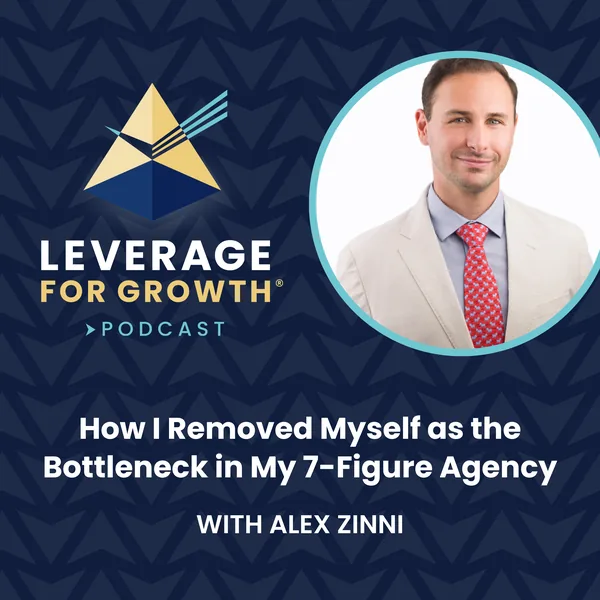
Alex spent a decade as the bottleneck in his own 7-figure agency. In 4 months inside the Leverage for Growth method, he built the systems to step out of it.
Listen to This Episode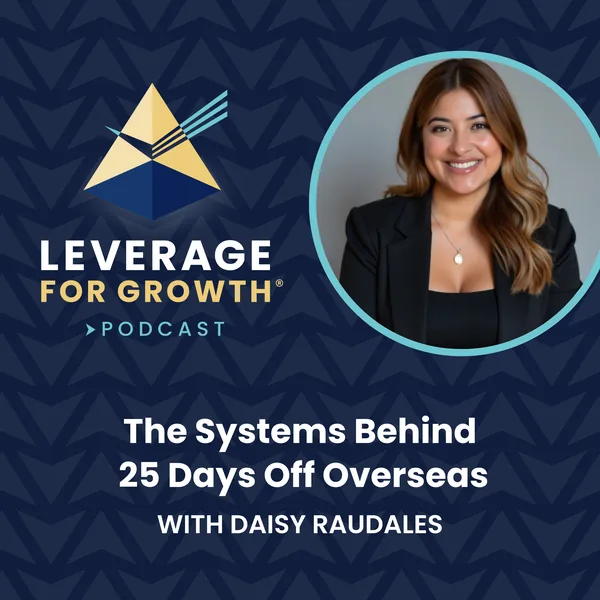
Daisy Raudales spent 25 days in Europe and her PR agency did not fall apart. She went a little viral for saying so.
Listen to This Episode