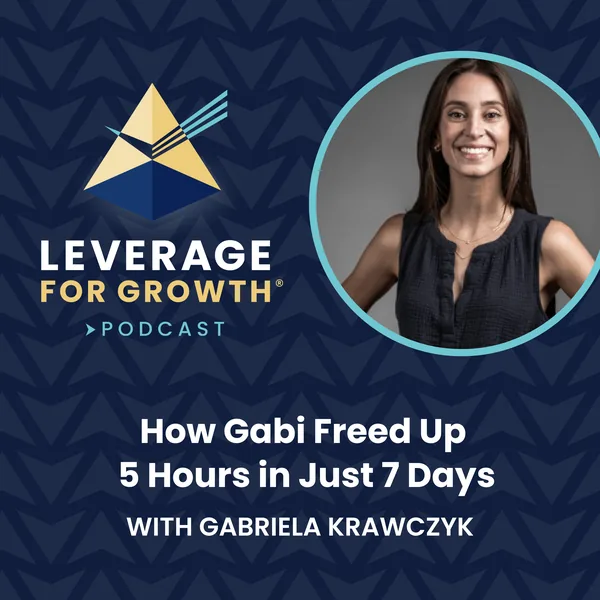
How Gabriela Freed Up 5 Hours a Week in Her First 7 Days
Gabi Krawczyk freed up five hours a week in her first week of the Free Up Founder challenge, and most of those hours came out of reactive work.
Listen to This Episode
LEVERAGE FOR GROWTH® PODCAST
April 16, 2025
What if the biggest bottleneck in your agency… is you? In this episode of the Leverage for Growth Podcast, Jesse Gilmore sits down with Dr. William Attaway — leadership coach, author, third-generation entrepreneur and the Founder of Catalytic Leadership LLC — to uncover why most agency owners unknowingly cap their growth by clinging to control. Discover how Cape Syndrome keeps you addicted to firefighting, why your systems (or lack thereof) reflect how you lead yourself, and the simple but powerful exercise that reveals how much of your time is actually spent doing what only you can do. If you want to stop being the bottleneck, build systems that scale, and create margin for creativity, this conversation is your wake-up call.
Dr. William Attaway is an Executive Coach specializing in leadership, mindset, and productivity who has been leading teams and coaching leaders for nearly 30 years. He's coached hundreds of entrepreneurs, agency owners, business leaders, and their teams on 6 continents, helping them to navigate and overcome the leadership and mindset challenges that can be overwhelming.
William has spoken at events and to teams including Seven Figure Agency, Prospecting on Demand, Spyglass Ops, the All-In Agency Summit, Extendly, The Committed Mastermind, SHRM, and MinistryPass.
He's written several best-selling books on leadership and is currently working on his third, which will be released in mid-2025. Pulling from his own nearly 30 years of leadership experience leading and coaching leaders and teams personally, as well as from the hundreds of leaders he has coached, clients have access to a knowledge base that is deep and wide, a coach who is FOR you, and a proven methodology that will help you stop spinning your wheels into overwhelm and overwork.
Connect with Dr. William Attaway & Catalytic Leadership: Web - https://www.catalyticleadership.net LinkedIn - https://www.linkedin.com/in/williamattaway/ Facebook - https://www.facebook.com/groups/catalyticleadership Instagram - https://www.instagram.com/wattaway/
This transcript is lightly edited for readability.
Jesse: Today I am here with Dr. William Attaway, leadership coach, author, and founder of Catalytic Leadership, where he helps agency owners and entrepreneurs scale intentionally by mastering the inner game of leadership, building productivity systems, and leading with purpose. Thanks for coming to our show today, William.
William: Thanks so much for having me. It's an honor to be here.
Jesse: Awesome. Can you tell us what inspired Catalytic Leadership?
William: You know, it really goes back to my story. I started in corporate, and when I began to lead other people and lead teams, I realized there was not a lot of great material to help me develop and grow, much less the people that I was trying to raise up and develop into leaders themselves. And so I started coaching leaders and teams almost 30 years ago now. That seems hard to believe. It's amazing how quickly that moved. As I began to do this in a lot of different contexts, first in corporate and business settings, then in nonprofit and church settings, and then my own practice, I was like, there's a real need for this.
People start a business because they're good at something, but hiring people and leading people and leading yourself, these are skills that most people don't have intuitively. How can I help? And that's why we started it.
Jesse: Mhm. Isn't it amazing? 30 years. Congratulations on 30 years. That's crazy.
William: My goodness, it flies.
Jesse: Well, my first question: you talked about leadership in corporate and then nonprofit and church. How did that experience with leadership impact your approach to coaching?
William: You know, coaching is such an incredible profession, because what I get to do is work with people where they are and help them move toward where they want to be. I start with the raw material, right? And so often people already have the answers to the questions that they're asking. They're just not asking the right questions. So what I get to do is come alongside them and help them see what they just can't see. It's really hard to see the whole picture when you're in the frame.
You need somebody on the outside who's going to ask you the questions that maybe nobody else in your world is asking you, so that you can see those things and overcome your blind spots. Who do you talk to when you have no one else in your world that understands what you do? Entrepreneurs are special. I'm a third generation entrepreneur. I watched my grandfather and my dad do this, and they didn't have somebody who came alongside them to help them see what they couldn't see.
One was wildly successful, one not so much. What was the difference? It was the people around them. And so now what I get to do is come alongside, ask those questions, help people overcome the obstacles in the way, which most often are between their ears, and then get to the level of success that they know they're capable of.
Jesse: I love it. The passion for coaching is obviously something that we share deeply. I guess the question is, how did this transition into your focus on agency owners? I know from a previous conversation there is a tie there based around generations, but talk a little bit about that.
William: Yeah. It's funny. I started working with some people in the agency space quite a few years ago now and really found a resonance there, and I wasn't sure exactly why until I really started to do some deeper work myself. You would think this is so obvious and self-evident, but it really took me some time, because you can't see the whole picture when you're in it. That goes for me too. My dad started a traditional advertising agency back in the 70s, and he ran it for 45 years.
It was traditional media. Digital didn't exist, of course, in those days. So billboards and radio and TV and newspapers. And I watched him build and grow an agency from nothing, just an idea. Build and grow, create jobs. That's what entrepreneurs do: create jobs for other people, build a team. But he couldn't get out of his own way. And the difficulty over time was that he became the lid on the business's growth. It would grow to a certain point and just beyond it, and then it would drop back, and then grow and drop back, and grow and drop back, because he became the lid.
He didn't have somebody alongside him. He didn't have a trusted thinking partner, if you will, that he could lean into. And it really did not occur to me. It's so crazy. In all these decades, it didn't occur to me that what I was doing, stepping in with other entrepreneurs and business owners and business leaders, and specifically in the agency space, was on a subconscious level becoming for them what my dad never had.
Jesse: It is kind of crazy how that happens. There are so many subconscious parts of our journey, especially as entrepreneurs, that sometimes it takes either a third party or a lot of introspection to figure out why I'm doing the things that I'm doing and why I feel drawn to it with a really intense purpose. And yeah, that's huge. That leads to the question of why it's so hard for people to lead themselves, even though developing yourself is the most important part of scaling.
In your experience, why does that seem so hard for people?
William: You know, I think you're the hardest person you're ever going to lead. It's so easy to point a finger and say, oh, if I had better team members. Oh, if they just worked harder. Oh, if they'd just do what I told them to do. Oh, if we had better systems. Oh, if we had better clients. You can point fingers all day long. But the reality, in my experience, is that most often the problem comes with the leader and how they're leading themselves. Most leaders, most business owners, most agency owners are firefighters.
They are moving from fire to fire to fire. Oh, it's time to call it a day. Go to bed. Get up. Rinse and repeat. Do the same thing again. And this is how they're leading. And your team follows how you lead, and they follow what you lead. So because of how they're leading themselves, this is now influencing not just them but their team, which is touching every one of their clients. Nobody likes to be in a fire. That's not anybody's dream. And so when you create an environment where the firefighter is doing this all day long, you're creating an environment where you're going to have high churn.
You're creating an environment with low retention. You're creating an environment that is going to cap and severely hamstring the results that you're able to get with fulfillment. All because of how the leader is leading themselves. Now, why do they do that? Well, there are a lot of reasons. One is what I call the cape syndrome, right? You think there's a cape hanging in your closet, and if you strap it on, you can swoop in and save the day. You like putting out fires because it gives you a dopamine hit.
Ah, solved another problem. You're the hero. That's great. If you have a cape hanging in your closet, let's talk. Most of us don't. And yet when you operate that way, you create systems that are dependent on you, where you are at the center of the spiderweb, where everything depends on you swooping in and saving the day. Well, that doesn't scale. And you're never going to be able to sell it, because you can't sell yourself. So you've got to ask yourself, what is it that you're trying to build?
What do you want to build? What's the system you want to live in? So much of this goes back to how you're leading yourself.
Jesse: Mhm. The moment you said the systems piece, I thought of the two different models. You've got the centralized model, which is all based around the founder, and then you have the decentralized business model, which is based around assets and systems and people. And I know the people watching or listening to this are in two different buckets. You have the people that haven't built the systems yet, where everything is based around them and their skills, so they're like, I can't even think about leading others at this point because they don't have the systems in place.
For those, obviously, you've got to lead yourself and build the systems. And then you have the people that have teams, and maybe they just don't know where to start. What would you say to either one of those groups? Where's a place to start?
William: You know, where I start with a client when they're in these spots: if they don't have systems yet, that's critical. If you want to build something that's healthy and sustainable for you and for your team and for your clients, you have to have systems. That's an absolute non-negotiable. It's not as complicated as it seems. It's not as intimidating as it seems. You start where you are, not where you think you should be, and not where you wish you were.
You start where you are and you build the systems one at a time, right? What is it that you're doing that somebody else can do? That's where we start, and we start with that list. What are the things you're doing that no one else can do, that only you can do? That's a separate list. We're going to build that out. My goal is to have you working on that list. Right now you've got all of it. We're going to start to really focus. And by building systems, you're able to delegate.
And by delegating, you're able to breathe, because you have margin. Margin is where creativity lives. Creativity is how leaders solve problems. If you feel like you don't have any space, you don't have any creativity, it's because you don't have any margin. So that's where I start with a client. We'll start with those two lists. We're going to build those two things out. And then we're going to say, okay, one at a time, let's build a system so that this becomes delegatable.
Does that make sense?
Jesse: Yeah, totally. For our clients, one of the things that we do to set up for that is a time log. It's the least sexy part of business: just log your time for seven days, every half an hour. And from there, we have a method of eliminate, automate, delegate, and then time block.
William: Yes.
Jesse: There are certain things that you're doing right now that you don't actually have to do. So if we can eliminate those, and then automation works really well for things that are predictable, like data transfers, things that are repeatable, you can automate that. And with the things that are left, looking at what you're talking about: is there something I'm doing right now that somebody else can do, so I can give it to them? And then whatever's left over, you start time blocking.
That one setup gives you the margin and space between the tasks and the people you're talking about. That one works pretty well.
William: Do you find people are really surprised when they do that exercise and they look at the results and see where they're actually spending their time?
Jesse: Yeah. And one of the funniest things is that a lot of it is subconscious. They'll start going through it, and three days in they're like, I know exactly what the issue is. And I'm like, keep going for seven days. Other times they have to look back on the entire thing and they're like, "Holy crap, my sleep patterns are all over the place. I'm waking up in the middle of the night thinking I forgot something and have to write it down," or whatever the issue is.
And in a very short period of time, you can take things that used to take a super long time and start narrowing them down so you have that space. I think the time log is one of the things I would just add to what you talked about, but I support everything you're saying.
William: That's a fantastic exercise. I love that a lot. I'm so glad you do that.
Jesse: Yeah. And one of the things that was really interesting, and I'm kind of going on a riff here: one of our mastermind clients recently kept on taking things over and over and over. He's like, "Oh, I'm just jumping in," like the cape that you're talking about.
William: Ooh, the cape. Oh, yeah.
Jesse: And I told him, "The future version of yourself is tapping you on the shoulder. That's the visionary. But right now, the doer version of you needs to die." And he's like, "What?" And I'm like, it just needs to die here. And I want to talk a little bit about the transformation that agency owners go through between six and seven figures. I know that you work in other masterminds and talk about leadership in this, and maybe you've seen this before. What got you here won't get you there, and I think it's pretty obvious that what gets you to six figures is doing everything.
And you can't really step into visionary leadership if you only have yourself to lead, right? Naturally what happens is you go from the doer, or the subject matter expert, and eventually you need to transition into a trainer. The only way that you actually move into the trainer role is you have to have the systems. Otherwise people are just following you around and it doesn't do anything.
William: That's right.
Jesse: Then from the trainer, eventually you've trained enough people and you start managing them, right?
William: Yeah.
Jesse: And then from the management piece, you have to build enough management systems in order for you to move into leadership. When you move into leadership, eventually you're leading the managers, but you're not really into visionary until you have a leadership team. So I think it's this five-stage process of going from a doer to a trainer to a manager to a leader to a visionary. What do you think about that model? That's just something I've seen working with agency owners, but what do you think?
William: Yeah, I would agree completely. I can see every one of those stages. I was talking with somebody yesterday who just crossed the seven figure mark, so they've been building and working very hard on exactly what you're describing. Systems, training other people, slowly building them up. All right, now developing leaders. All right, now putting together a leadership team. And shockingly, as they have built all those things, the company has continued to scale and grow.
It's amazing how that happens. And as they do that, they're able to take their hands off, and in theory they're able to do less but accomplish far more. And the way I often describe this, Jesse, is you have to move from being an individual contributor into being a CEO. What that means is that your job is no longer about getting things done. Your job is about getting things done through other people. You are investing in your leaders, your leadership team.
Your leadership team is then investing down into the organization until everybody is touched. Your job is not to do it anymore. And that is the turn that I find most entrepreneurs have trouble with. Most people will not make that turn because they find the dopamine hit, the cape, the swooping in, the doing. They will not make the turn because they don't want to give that up. And when I have this conversation, the way I frame it is I say, "Here's the thing.
If you want to build a lifestyle business where this is all about you, where you're doing, that's fine. It's your business. You get to decide." As you wrote about in your book, you have agency, right? You get to choose. But if you want to scale, and if you want to build this into something that becomes a sellable asset, this isn't going to get you there, because everything is still touching you, and you've got to get out of that.
Jesse: Man, I feel like we should have coffee and dinner and hang out, because we're literally in the same zone here. One of the interesting things about that transition from the individual contributor to the CEO is that there are so many different skills involved, different from what gets you from freelance into agency. The skills that need to be developed are the transferable business skills. And sometimes it takes a mindset shift or reframe: how am I contributing to the agency, and what is the best value I can give to the agency?
Because that role and that value switch, and it's not always about the dopamine hit like you were talking about. I think one of the greatest things that can happen is that mindset shift, because you can feel more fulfilled by somebody else doing it. Dan Martell, in his book, has this saying: 80% done by somebody else is 100% awesome. That one, I was like, "Oh, that's such a good one." That one statement got me thinking about the mindset shifts that everybody has to make as they transition.
And a lot of our role is most likely working more on the mindset portion than on tactics and all that kind of stuff. I think it has way more to do with how you're viewing the business and how you're viewing value to your team, to yourself and to your clients, and I think that shifts and evolves over time.
William: Absolutely. And I think you have to be honest with yourself. What is the business you want to build? What is the life you want to live? You get to choose that, right? And whatever you choose, great. Just be consistent. Have the integrity to be consistent and operate in accordance with what you say you want to build. Don't say you want to build something that scales and is sellable and then say I have to touch everything. It's not going to work. You have to have the integrity to have consistency.
A friend of mine says consistency is the mother of momentum. Everybody wants momentum. Consistency is how you get there.
Jesse: It reminds me of, have you ever heard of the CQCQ model?
William: No, I don't think I have.
Jesse: It's a step-by-step. If I had a visual, it would just be steps. I was taught it when I was learning about systems and process in corporate. They say that consistency is the foundational step. Everybody wants volume and so forth. If you figure out consistency, what naturally starts happening is that you focus on quality, the quality of the consistency. So it's a frame. When you're consistent and you have quality, it leads to confidence. And when you have confidence in whatever you're doing, it leads to quantity.
Anytime someone's having an issue with volume, focus on consistency. If you're having an issue with confidence, focus on quality. It gives you a frame for when you're building something, whether it's habits or systems or standards or whatever it is. You have a step-by-step process to get there.
William: Oh, I love that. That's brilliant. Consistency, quality. I might check that out. Thank you. That's brilliant.
Jesse: You've got me thinking. I see all the books in the back and I'm like, "Yes, I taught Dr. William Attaway something new." Heck yeah, dude.
William: You know, one of the things that I talk about with clients is the importance of a teachable spirit. One of the commitments that I make every morning is I want to be the most teachable person in every room I walk into and in every conversation I'm in, because I believe you can learn from anybody. Sometimes you learn what not to do. Great. That's still valuable. But if you're receptive, you can pick up all kinds of stuff like this. Did I come into this expecting to learn about CQCQ today?
I did not. But I'm going to be thinking about that for the rest of the day, thanks to Jesse. Thank you.
Jesse: Boom. If that's my biggest impact, the CQCQ model in your world, that's so good, man.
William: I love it.
Jesse: Cool, man. Well, it's been a good talk. If there's an agency owner listening to this and they want to know more about you, or read your book, what's the best way of getting in contact with you?
William: You can go to our website, catalyticleadership.net, and see all the different things that we do. I do one-on-one coaching. I work with teams and different masterminds and companies, with off-sites and retreats and all manner of things. I speak at a lot of different agency events. And you can always connect with me on LinkedIn. I'm pretty active over there, and I would love to connect with your listeners. If there's a way that I can be of service and assist, I'm always happy to do that.
Jesse: Awesome. And for anybody that's listening, I will include all of Dr. William Attaway's links, including his website and LinkedIn, in the show notes. And William, thank you so much for coming on the show, man. It's been awesome.
William: Hey Jesse, thank you for having me. I always love our conversations. This was no exception. So good.
Transcripts are auto-generated and may not be 100% accurate.
Gabi Krawczyk freed up five hours a week in her first week of the Free Up Founder challenge, and most of those hours came out of reactive work.
Listen to This Episode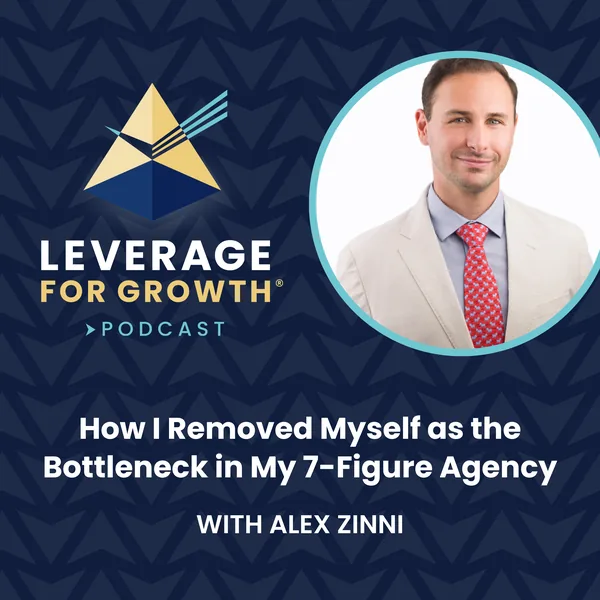
Alex spent a decade as the bottleneck in his own 7-figure agency. In 4 months inside the Leverage for Growth method, he built the systems to step out of it.
Listen to This Episode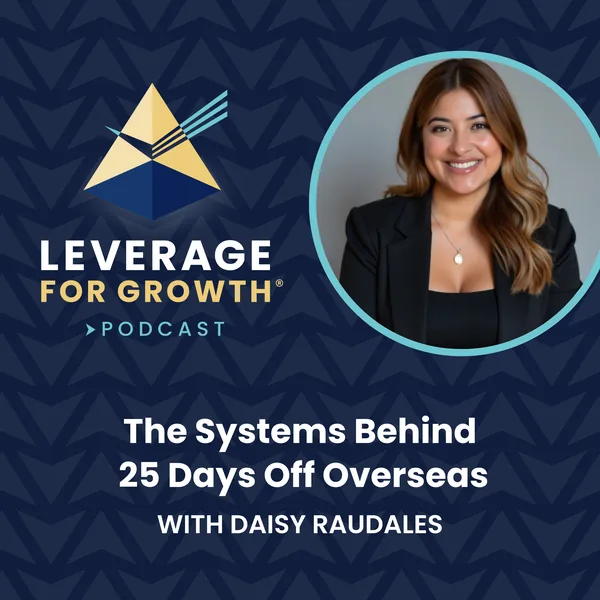
Daisy Raudales spent 25 days in Europe and her PR agency did not fall apart. She went a little viral for saying so.
Listen to This Episode