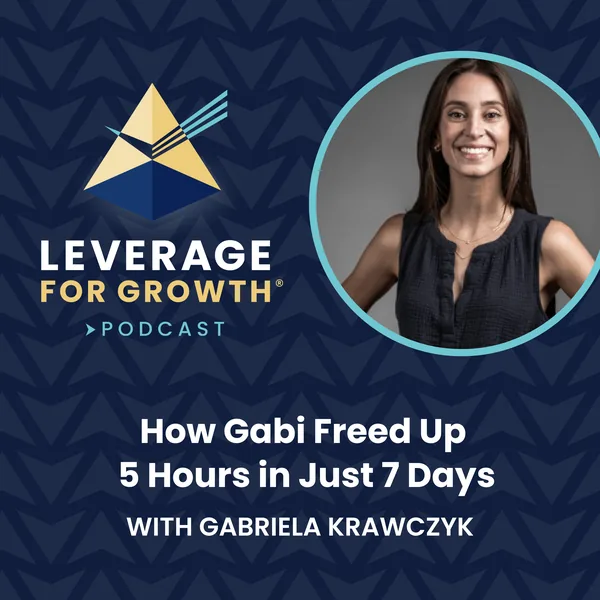
How Gabriela Freed Up 5 Hours a Week in Her First 7 Days
Gabi Krawczyk freed up five hours a week in her first week of the Free Up Founder challenge, and most of those hours came out of reactive work.
Listen to This Episode
LEVERAGE FOR GROWTH® PODCAST
May 23, 2025
️ In this episode of Leverage for Growth, Jesse Gilmore sits down with James Lincoln—founder of Goodly—to unpack the real metric that matters: freedom. What started as a side hustle during James's MBA turned into a thriving agency doing $40K+ months. But what truly drove him wasn't money—it was the desire for time freedom, autonomy, and a business that supported the life he actually wanted. You'll hear how James: Built an agency while balancing school, a job, and two kids Delegated early by necessity, not luxury Learned to trade revenue for life ownership Built global teams without sacrificing quality Accidentally scaled into something sustainable—and freeing Whether you're stuck in the grind or scaling with intention, this episode will shift how you think about success, ownership, and the role your business plays in your life. Hit play and discover why freedom might be the most important KPI you're not tracking.
" I'm building my agency to 100k (75% of the way there) and building as much time wealth as I can along the way." - James Lincoln
Connect with James Lincoln and Goodly - Web: https://goodlygrowth.com LinkedIn: https://www.linkedin.com/in/james-earl-lincoln/
This transcript is lightly edited for readability.
Jesse: Today I am here with James Lincoln, the founder of Goodly, a fast growing digital agency helping local businesses stand out with high converting websites, optimized Google business profiles, and results-driven local SEO. James has built his agency using smart systems, strategic delegation, and a clear focus on scaling without burning out. His journey from a side hustle to a sustainable business, one he now runs with a few hours a day, is a roadmap many agency owners are trying to follow.
Today, he'll share how he did it and what it really takes to step out of the day-to-day operations and to grow an agency that runs without you. Thanks for coming to our show today, James.
James: Awesome, man. Good to be here. Thanks for having me.
Jesse: Absolutely. So, can we start off in the beginning and tell us a little bit about the background of your agency?
James: Yeah. So, I started Goodly, you know, really out of necessity. I was doing an MBA program, was running out of money faster than I thought I would be. And the goal of the MBA was to buy a business. I was really into the ETA, like using an SBA loan, buy a blue-collar business world. And, you know, my second semester of the MBA program, I was running out of money. I need to get some cash flow in order to be able to search for a business after I graduate and avoid getting a job.
And I'd had a background selling to the market of home service owners. I'd started a little software company with some partners, you know, five, six years earlier, and so I knew the market. I knew that people needed good SEO and I just got after it.
Jesse: Awesome, man. So, you built the agency while getting your MBA.
James: Yep, I did.
Jesse: How are you figuring out that whole juggle? For a lot of people just running a business in itself is kind of a challenge. But doing that as you're getting an MBA, how did you figure out the balance and how were you able to grow the agency while also getting your degree?
James: You know, I'll make a little plug here for MBAs, right? I know a lot of people think that they're not necessary anymore or maybe not worth the time off. But for me, I went and got an MBA with a really narrow focus, which again was to buy a business. I went to BYU, which as far as MBAs go is extremely affordable. And I came to find out through the program that when I started Goodly, there was a ton of resources at the university that helped me be successful, right?
Like I was getting credit for working on my business. There's grant money. I actually didn't get any grant money, which is a whole other story. I probably should have got a little bit of that. But, you know, they gave me office space. I was able to connect with people. It was phenomenal, right? Being able to play that student card. And so for me, I came out of the MBA with no debt. No school debt. I think I had a little loan I took out to live off of that I paid back when we graduated.
And it was easy for me to build the business during the program because that's all I cared about. I wasn't looking for a job. My classmates, you know, they were out there networking with companies that they might want to go work for, and that's not what I spent my time doing. I went to probably half the classes my classmates went to because I was getting credit for my business, and I was networking with business owners that were doing what I wanted to do and selling.
So, it was a phenomenal time, and in hindsight my wife would never have let me quit my job to start a business. The risk profile doesn't match up there, and frankly I probably would have had a hard time doing that too. I know myself. The MBA was a really good bridge where I'm not expected to make money during the program. I didn't burn any bridges leaving the company that I was working at beforehand. That was always in my back pocket. I could go back there.
It was a really effective two years because I had such a narrow focus.
Jesse: Awesome, man. You're kind of reminding me of my college days, too. I had a very narrow focus. Everybody else was all over the place. And how long have you had the agency?
James: So officially, I say I launched it in February of 2023, so it's been a little over two years. I dabbled a little bit in it the summer prior to my MBA program starting. I'd had a former partner that was doing something similar and was like, "Hey, you should do this. You'd be good at it." I'm like, "I'll give it a shot." And, you know, I closed three customers and was like, "Meh, this is hard and it's not what I want to do." So I just kind of let things ride with them and laid off my cold caller and shut things down, not expecting to get back into it.
But then when the time came where I need a little bit of money, I'd had that three or four week experience where I'd built some of the framework to go out and actually build that agency. So I say I launched it officially in February, but I did have a little three to four week stint six months earlier.
Jesse: Sure. And bring us kind of back to the beginning piece. Obviously, there was a need for money. You were doing it at the same time as the MBA. I know you're a systems person because we've talked before, but what were some of the first things that you were implementing in the beginning to gain traction and figure out how to grow this thing while you're also focused on the MBA?
James: Yeah. So on top of the MBA, I actually had a job. There's a story around why that happened and a deal I was looking at that I needed a HELOC for. But I was also working, right? So the constraint on my time was just so high. We had two little girls under three at the time. I wanted to be able to spend time with my wife. It was a crazy time. In the moment it didn't feel crazy, but looking back I'm like, oh man, that was pretty wild. But because of that, I was just forced into the systems, right?
I can't go cold call. I just don't have the time to cold call. And frankly, I started out by saying I just need a way to make some money to be able to go do what I really want to do, which is go search for a business and buy a business. I just needed to cover our cost of living. And we were at the time living on like five to six grand a month. So, okay, all I have to do is clear that. And so I wasn't super stressed about going out and getting $10,000 in the first two months in revenue, because I had that job that was giving me some money.
I wasn't expected to be making a ton of money because I'm in the MBA program. And so I went out and I hired a cold caller and I was like, "All right, let's see what he brings in. If it's not a ton, I won't be that busy, and if it's a lot, then I'll be a little busier, right?" It didn't matter a ton because I didn't need the money right away. But it was a long tail. I need this money so I can not have to have a job when I graduate. And so that was a bit of a luxury, right?
Being on the lookout 12 months and saying, "Well, I just need to be making $5,000 a month 12 months from now, and until then I'm fine." If I go into debt, that's not a huge deal, because I can always up my cost of living a little bit and pay back the debt. And because I was so time constrained, I hired a cold caller and they just made calls and passed me warm leads, and I would follow up with the warm leads. I closed a few deals that way. I still had, actually I think I only had two of the three that I had closed the previous summer.
So when we started in February, I think we closed February out right around a thousand dollars in MRR. And then by March we were at 4,000. So I'd closed a few more deals in March. And at that point I'm like, "Oh, this is going pretty well. So what can I do? I'm becoming a bottleneck here. I'm going to go hire some salespeople." And so I hired a couple US-based sales guys for minimum wage plus commission, and neither of them really panned out. It's a long story, but one of them is still with me today and he's been phenomenal, right?
So he did pan out, but he wasn't good early on, and he actually left for a little bit. And then school ended. So from March till the end of April, I'm like, I've got my SDR calling, I've got these sales guys who are supposed to be closing deals. They didn't close any. But then school got out at the end of April and I had a little bit more time on my hands. I had an office from the university, and that's when I just got in to closing deals. And I was able to go back through all of the leads that we'd had from February through April that were in the pipeline of my sales guys.
It was nice because I was busy, because we had a couple hundred leads that had some contact. I wasn't just relying on two to three leads a day from my cold caller. I was getting that, but that was on top of this backlog of leads. So I just got after that. And to rewind a little bit more and talk a little bit more than just sales, again because of time constraints, I hired someone right off the bat to do the delivery work on the SEO side. He's based in the Philippines.
He's still with us today. He actually runs our entire SEO operation now. I think he's got like 12 direct reports. And it's just grown with the company, right? Which is kind of the vision I sold him on. And so it was just out of necessity. I just couldn't ever get involved in a lot of stuff. I was like, "Well, I need to go sell. You can handle the SEO." And I had a freelancer early on that we did web development with. She was really good. I had to go through a few to find someone that was good.
And now we have all in-house developers. But yeah, the time constraints forced me into these delegation systems early on, and they weren't great. There was a lot of stuff that broke over the ensuing months as we grew, and I'm like, well, yeah, Google Sheets probably isn't the best way to track tasks. You know what I mean? Probably not.
Jesse: But everybody's got to start somewhere, though, right?
James: Got to start somewhere. My mindset is don't overcomplicate things. The most important thing in any business is sales. You've got to have revenue. If you're out there building automations and these task management platforms and all this crazy stuff, and you have no sales, you're just wasting time. So do the hard stuff first. Go get revenue and you can figure out the back end. It might have cost me a couple customers early on because maybe we dropped the ball, and that happens.
That's a bummer. But the flip side would have been I spent all my time getting the systems dialed and I just never go get customers, and then we'd be in a completely different boat today.
Jesse: Yeah. And this is really cool, getting to understand some of the first moves. I always think about business as kind of like a chess game. You're choosing which piece to move and what's going to get you what you're wanting. And it seems like that foundational piece of getting the setter or the cold caller and then also some fulfillment figured out made it a lot easier for you to jump in and jump out. And there's another thing that you said which I think most people should do very intentionally: creating time constraints, whether they're external, based around having kids, an MBA program and everything else that was going on in your world, or based around their own choice to say, I'm going to work this certain amount of hours, and anything that goes beyond that, I have to figure out what to do.
I think that was kind of a recipe for growth. So, fast forward a little bit. How has the business evolved over the last couple of years, going from that foundation to where it is today?
James: Yeah. So we got through that first summer and checked the box, right? I was happy because we'd hit 10,000 in revenue. That was kind of the mark I was trying to hit. We had enough where I could say, "Yeah, we're going to make the money we need to cash flow our lifestyle." And it sounds silly, and I've talked to my team about this, and I feel a little embarrassed by it sometimes, but because the end goal was to go buy businesses, it wasn't to run an SEO agency.
At that point, I was like, "Okay, I did it. I'm done." And sometimes luck comes your way. That sales guy I hired originally, one of the two, came back and was like, "Hey, I'm ready to actually give this a shot." And I'm like, "Well, yeah, dude. Go for it." I don't need to sell anymore, because I cleared the bar that I was trying to hit. And so that was June of 2023. And it just took off with him, right? Something clicked and he was able to figure out how to sell, and we still had all the systems for leads coming in.
I was never going to shut it off, because I figured, well, worst case, four months from now I can just go call back four months of backlog of leads. And so I wasn't super focused on it through the rest of my MBA program, that whole second year. I tried a few things, right? I tried to hire a bigger sales team and I wasn't good at that. I made some assumptions that were wrong, and so that was a huge suck on my time. I hired a customer success manager, which was incredible because that took me out of the day-to-day.
And now I had a system that just worked, right? We'd close a deal, they'd get onboarded, they'd get the delivery done, they had someone to contact for support. We were delivering a really good service, and I didn't have to be super involved. I was paying for it, right? So my cash flow was going down, but again, I didn't need that cash flow at that time. But then graduation comes around in April of 2024, and at that point we were doing like $40,000 a month in revenue, and I'm like, "Oh man, I actually have kind of a business here.
This is kind of legit, and I just feel like I accidentally stumbled into it." It probably took me another three to four months to really accept that and let go of the dream of going and buying a business, because ultimately, what am I trying to do here, right? I want to own a business so that I have time freedom and I control my outcomes and I can live the life I want to live. Time freedom doesn't mean I don't work, right? Sometimes I work a ton and other times I work a little bit less.
But I control my outcomes and I have a direct path to say, "Hey, if I want to double my income this year, I know how to go do it. It might require a ton of work, but I can go pull it off, because I have this platform to grow with." And that was kind of the whole vision in owning a business: live the life I want to live. I had a business under contract that summer, and a couple people close to me just said, "Man, you're trading a business that you know works, with no debt, for a business you don't know that's going to have a ton of debt." And I'm like, "That's a good point." I wasn't going to make much more than I was making in Goodly.
And so I kind of just accepted it and was like, "Yeah, this is a good business." And for the past, we'll say eight or nine months now, I've just been gung-ho that this is what I'm doing and this is the business I'm building, and I've continued to build a better team and invest more into the team. We've invested a ton into our team and our processes and our systems. And it's funny, dude. Sometimes I do these podcasts, and I actually had a customer, you get bad customers, right?
And this customer reached out and was like, "Hey, I heard you on a podcast. I never want to work with you again. You just outsource everything." I'm like, okay, whatever, dude. That's fine. In reality, we don't outsource anything, right? We build teams globally, but they're internal teams, and we deliver a great service. Just because I have time freedom doesn't mean we deliver bad service. It means that I've paid for the team to go do this. It's a trade-off.
And this is what people don't realize sometimes: I could go spend 15 hours in my business, and let's say I make 200 grand doing that, right? Or I could make 110 and hire somebody for 90 grand that's going to save me probably 12 hours of work, right? It's just a trade-off. The owner doesn't necessarily have to be the one running the day-to-day of the business. And I think most business owners you talk to will say they don't want to do that, whether they're a blue-collar business owner or an agency owner or doing anything, right?
The whole point of being an owner of a business is you want to work on the business and you want to have a platform to grow. And spending 12 to 15 hours a day in the business talking to customers, you can pay somebody to do that, and you can focus on some bigger things. So that's where I've been focused for the last nine months, and things have been good. We almost doubled again from April to April. And things are humming along. So I'm hoping to build another sales team and scale that up again, hopefully with some lessons learned.
We've got two full-time US-based salesmen and four full-time SDRs right now. And I'm hoping to get that up to maybe six and 12 in the next few months. Our delivery team is up to maybe 17 right now. The delivery team's doing really well. I'm actually trying to promote that customer success manager I hired to kind of be the CEO of the business now, so I can just focus on growth, and he can handle all of our systems and everything. So things have been really good, man.
I feel really lucky to have landed where I am. Sometimes it feels a little bit by accident, but there was a lot of work along the way.
Jesse: Yeah. I think there were a lot of smart moves. It's that chess game again, where the moves that you made were based around the desire, or the desire kept on changing as you hit certain milestones, and you hit a certain milestone where you decided not to split your attention between a business that you might buy and the business that you own and can just grow. And you talked a lot about freedom. I wrote a whole book about what you're describing right now, which is leaning into that whole freedom aspect, because no entrepreneur truly gets into starting a business just to own a job.
And I think one of the most beautiful things that you did over these last few years is you're building systems and people. It doesn't really matter where the people inside your team work from, global or not. And it doesn't matter that the business doesn't run based around your skills. What really matters is the customers get good results consistently and they have everything that they need. And that's what you're setting up, which is part of the reason why you're doubling each year, which is pretty sweet.
So that kind of leads toward: what are you excited about in the next one to three years with your agency?
James: Oh, it's a good question. And maybe before I answer it, I want to hit a little bit on what you said about freedom again, because this has been top of my mind, right? I didn't know that what I was searching for was freedom. I'm 30 years old, and when I was 25 I had a really good job working in healthcare IT down in Dallas, and at that point I thought all I want is money, right? I want to make as much money as possible. It's a little naive. I think it's normal for people to think that way.
But I had some mentors who kind of told me, you're stupid, that's not all that matters. And in reality, I look back with hindsight and I'm like, really, all along I was just searching for freedom. And I had a lot of freedom in that W2. You don't have to own a business to have time freedom, right? Which is really just control over your time. If you do a good job and people can depend on you and know that you're going to get the work that needs to get done, and this is the most important part, you work for the right person, you have the right boss, you can have time freedom.
I controlled probably 70% of my calendar when I worked that W2. And as long as I got my work done and built a reputation for getting that work done, I had time freedom to say, "Hey, I want to take a little time during the day to go to Costco with my family or play with my daughter," who was one at the time. You can have that freedom. And now I look at where I am today, and it's really cemented in my mind that's all that matters to me. The money comes and goes, right?
Sometimes I literally feel like I'm the wealthiest person in the world because I control 100% of my time. I don't do anything I don't have to do or don't want to do. Sometimes I do stuff that I'd rather not do. I don't love closing my books every month. But that's okay. And my point being, you can achieve time freedom and time wealth far before you amass a huge number of dollars. And the younger you are when you realize that, the better. Because I'm 30 years old, I've got three kids under five now, and this is the time to have freedom, right?
To be able to spend time with them. And I want the same for my team members. Everybody in my company for the most part has that time freedom. They have to earn it. And there's a level of trust you have to get to before you can say, "I don't really care what you're doing at 2:00 on a Thursday as long as I know the work is getting done." But I've had to reconcile that in my mind: how do I focus all of my energy on building time freedom but lock other people into these W2s?
And I do that by saying you can have that freedom. There's nothing preventing you from having that freedom, barring that you're dishonest or slacking off and not getting your work done. So that's been such a focal point in my life for the past year, learning that what really matters to me is that I can go work on what I want to work on. And when you can do that, the money comes, right? I'm not worried about the money, because I know it will come over time.
So what am I most excited about over the next couple years? Just continuing to build. I'm driven to build. I love to build. I've got my sights set on building a digital platform that can serve small businesses. I'm really into education. I've completed a master's degree. I'm actually thinking it would be cool to go do another degree. I think there's a huge opportunity for digital education. I'm teaching this fall at a university. I think there's a platform to be built there.
And the more that I can build this ecosystem where all my efforts are leveraged in helping other businesses, whether it's building a global staffing company, because I hire globally, and building the infrastructure there to hire high quality talent just helps my business a little bit more, right? Or scaling paid ads. I could have a separate paid ads company that serves all of my customers at Goodly and vice versa. We don't do paid ads now, but that's something that we could build out.
I don't know, dude. I'm just excited. I feel this immense freedom ahead to build what I want to build, and that's really exciting. So that's probably what I'm most stoked about over the next few years. And doing it with cool people. I've got a really good team of people and I'm excited to build alongside them.
Jesse: There are so many things that we could talk about just based on what you just said. But yeah, super exciting, man. And you can actually tell in the sound of your voice that you are very excited about building either different branches of the same company or different companies that support each other, or big infrastructure. Very exciting, man. For those that are listening who maybe want to get in touch with you or learn more about Goodly, what's the best way to get in contact or learn more about what you've got going on?
James: Yeah, I'm on LinkedIn and Twitter a lot. That's probably the best way to reach me. You can always email me at james@goodlygrowth.com. I'm easy to get a hold of. I love connecting with people, and I think there's a ton of value in building relationships. So that's kind of where I'm focused right now.
Jesse: Awesome. And for anybody that's listening, I'm going to include links to James's social media profiles and Goodly in the show notes. And James, I just want to thank you so much for sharing your story and being on the podcast.
James: Oh, thank you for having me. It's great to be on.
Transcripts are auto-generated and may not be 100% accurate.
Gabi Krawczyk freed up five hours a week in her first week of the Free Up Founder challenge, and most of those hours came out of reactive work.
Listen to This Episode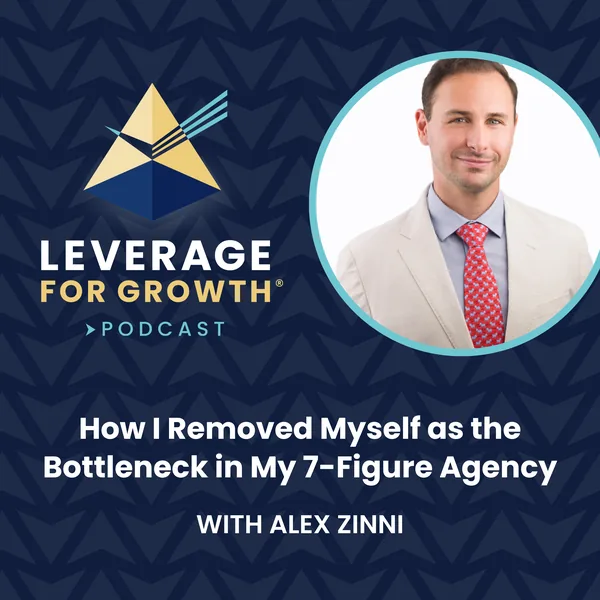
Alex spent a decade as the bottleneck in his own 7-figure agency. In 4 months inside the Leverage for Growth method, he built the systems to step out of it.
Listen to This Episode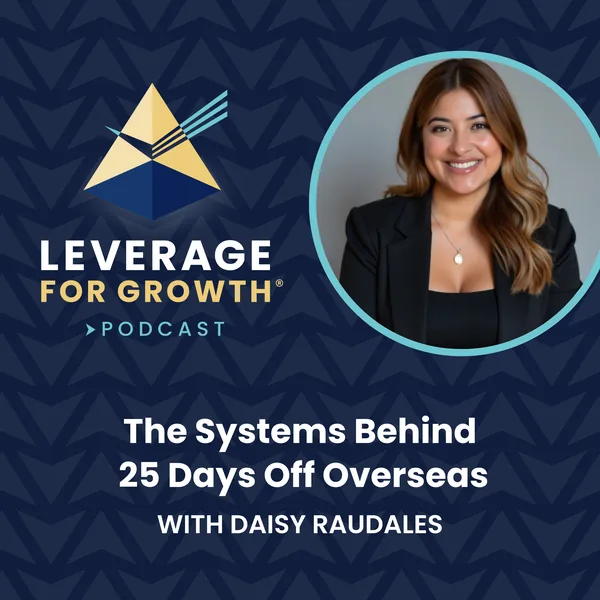
Daisy Raudales spent 25 days in Europe and her PR agency did not fall apart. She went a little viral for saying so.
Listen to This Episode